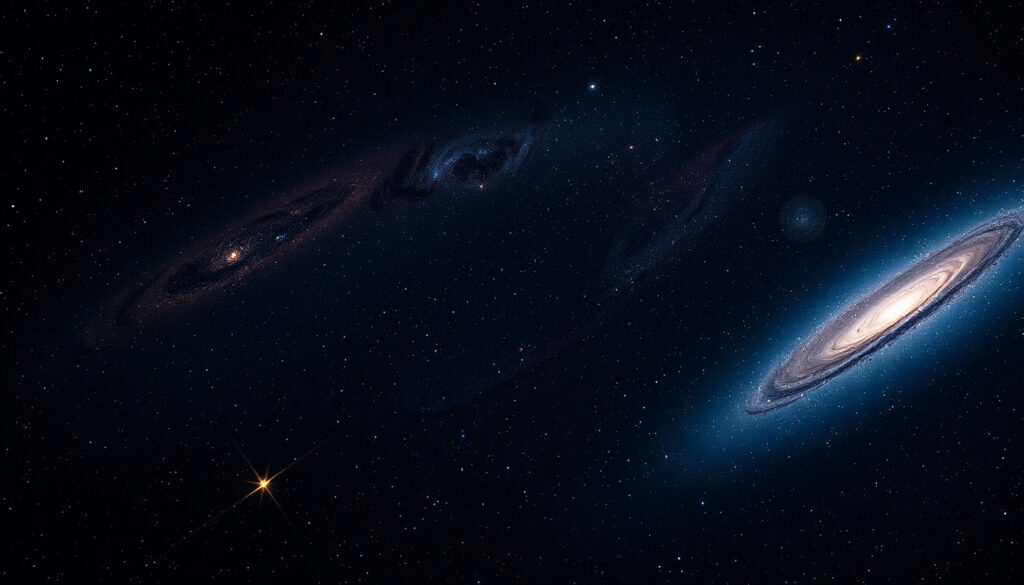
How Many Galaxies Are There in the Universe? Estimates and Facts
Few questions in astronomy spark as much curiosity as the simple one: how many galaxies are there? For decades, astronomers have updated their estimates as telescopes improve, and the numbers have jumped dramatically—from millions in the 1920s to trillions today. This article traceshow the count has evolved, what the latest instruments reveal, and why the answer is still not fully settled.
Estimated galaxies in observable universe: 200 billion to 2 trillion · Galaxies in the Local Group: Over 50 · Average stars per galaxy: Approximately 100 billion · Largest known galaxy (IC 1101): ~4 million light-years across · Age of the universe: 13.8 billion years · Oldest known galaxy (GN-z11): Formed ~13.4 billion years ago
Quick snapshot
- At least 200 billion galaxies in the observable universe based on direct counting (Big Think (science and technology outlet))
- The Local Group contains over 50 confirmed galaxies (NASA (space agency))
- IC 1101 is among the largest known galaxies, diameter ~4 million light-years (Wikipedia (community‑edited encyclopedia))
2022–2025: JWST refines counts, may reveal 6–20 trillion galaxies (Big Thinkspan>What’s next
=”n24-card-body”> survey like Euclid and Roman will map billions of galaxies (NASA)
The table below brings together the most widely cited numbers—what we know and we’re still debating—about the galaxy population of the observable universe.
| Fact | Value |
|---|---|
| Number of galaxies in observable universe | 200 billion – 2 |
| Number of galaxies in Local Group | Over 50 |
| Largest known galaxy diameter | ~4 million light-years (IC 1101) |
| Oldest known galaxy age | ~13.4 billion years (‑z11) |
| Average stars per galaxy | ~100 billion |
| Estimated total stars in observable universe | × 10²³ (200 sextillion) |
How many galaxies are universe?
Current estimates from Hubble and JWST
The most frequently cited figure for the number of galaxies in the observable universe has shifted dramatically over the past three decades. The Hubble eXtreme Deep Field, one of the deepest images ever taken, identified 5,550 uniquely identifiable galaxies in a tiny patch of sky (Big Think (science and technology outlet)). Extrapolating from sample, astronomers estimated roughly 170 billion galaxies. But that number came with a catch: the Deep Field could only see bright, relatively nearby. What about the faint ones?
The 170‑billion figure was always a lower bound. Every new generation of telescope finds galaxies that were invisible before.
How astronomers count galaxies
- Step 1: Point a telescope at an extremely dark patch of sky for days or weeks.
- Step 2: Count every galaxy-like object in that image.
Step 3: Divide the total sky area by the area of the patch, multiply by the count, and you get a rough total.
But this method misses galaxies that are faint or too distant. Theoretical simulations that model galaxy formation far higher numbers—around 2 trillion (Big Think). And recent observational evidence, based on how many small satellite galaxies accompany every Milky‑Way‑like galaxy, suggests the real total could be6 and 20 trillion (Big Think). The James Webb Space Telescope, launched on 25 December 2021 NASA (space agency)), is testing these predictions by spotting galaxies too faint or too redshifted for Hubble.
Theories and observations are still diverging by an order of magnitude. The true number likely sits somewhere between 2 and 20 trillion—a gap that only more data can close.
The implication: each new instrument widens the gap between direct counts and theoretical predictions, forcing a continuous revision of our picture.
Is the Milky Way 1 galaxy?
What defines a galaxy
A galaxy is a gravitationally bound system of stars, stellar remnants, gas, dust, and dark matter (Wikipedia (community‑edited encyclopedia)). The Milky Way is a single, large spiral galaxy—not a cluster of galaxies. It contains 100–400 billion stars and spans about light-years across (NASA). Дізнайтеся більше про те, скільки галактик у Всесвіті, за посиланням найкращі навушники 2025.
Structure of the Milky Way
Our galaxy has a barred spiral structure: a central bar-shaped bulge of older stars, surrounded by spiral arms rich in gas and young stars. It belongs to the Local Group, a collection of over 50 galaxies coherent system.
The implication: “Milky Way” is a proper name for a specific galaxy, not a generic term for a group. When people ask “how many galaxies Milky Way?” the answer is zero—it is the galaxy itself.
Which is the galaxy in the universe?
IC 1101 and other supergiants
IC 1101, located at the centre of the galaxy cluster Abell 2029, has a diameter of about 4 million light-years (Wikipedia). That makes one of the largest known galaxies by stellar extent. But size can be measured in different ways.Alcyoneus, a radio galaxy, has giant lobes extending more than 5 megaparsecs (about 16 million light-years
How galaxy size is measured
- Stellar disk diameter: the visible spread of stars (IC 1101 wins among
- Halo size: the‑matter‑dominated outer region (often much larger).
- Radio lobes: jets of material can extend millions of light-years (Alcyoneus).
The pattern: “biggest” depends on the definition. In sheer stellar mass, IC 1101 is a titan in radioAlcyoneus everything.
More related posts
 Me and Em UK – Stores, Online and Returns Guide
 Sharp Sand Bulk Bag – Ideal for Concrete Mixing and Screeding
 Slash Guns N’ Roses: Health, Feud, Family & Style
 Ca t of The Hateful Eight: Full Li t of Actor and Character
 INDW vs SL-W – Complete 2025 T20I Series Results and Scorecards
 Winter uPVC Window Energy Cost – UK Prices and Savings Guide
 What Is Sertraline Used For – Dosage, Side Effects and More
