Leonardo da Vinci: Famous Works, Death Cause & Right Hand Palsy
Few figures from history feel as modern as Leonardo da Vinci. We know him for the Mona Lisa’s elusive smile and flying machines sketched centuries before the Wright brothers, yet his final years hold a puzzle that still divides medical experts today. This article separates the documented facts from the retrospective diagnoses, examining what we actually know about his death, his right hand palsy, and how the man who embodied the Renaissance spent his last days. You’ll find a clear picture of the evidence — and where the gaps remain.
Born: April 15, 1452, Anchiano, Italy ·
Died: May 2, 1519, Amboise, France ·
Known for: Painting, drawing, engineering, anatomy, invention ·
Famous works: Mona Lisa, The Last Supper, Vitruvian Man ·
Cause of death hypothesis: Right hand palsy, possible stroke
Quick snapshot
- Italian Renaissance polymath (Encyclopaedia Britannica)
- Painted the Mona Lisa and The Last Supper (National Gallery, London)
- Died on May 2, 1519, in France (Encyclopaedia Britannica)
- Exact cause of death not documented (Encyclopaedia Britannica)
- Last words attributed by Vasari may be unreliable (Encyclopaedia Britannica)
- ADHD is a retrospective hypothesis only (Brain journal (PubMed Central))
- 1517: Right hand impaired, still drawing left-handed (National Geographic Historia)
- 1519: Dies at Clos Lucé, Amboise (Encyclopaedia Britannica)
- Continued medical debate: ulnar palsy vs. stroke vs. median nerve injury (Journal of the Royal Society of Medicine (PMC))
- No new primary sources expected; debate relies on reinterpretation of existing evidence
Six key facts, one pattern: the gap between what is confidently known and what remains medically speculative is wider than most biographies admit.
| Full name | Leonardo di ser Piero da Vinci |
| Birth date | April 15, 1452 |
| Death date | May 2, 1519 |
| Nationality | Italian (Florentine) |
| Known works | Mona Lisa, The Last Supper, Vitruvian Man |
| Key disability | Right hand palsy |
The same 1517 visitor who reported Leonardo’s paralyzed right hand also noted he was left-handed and could still draw. The disability may not have ended his productivity — but it did end his painting.
What was Leonardo da Vinci famous for?
His masterpieces: Mona Lisa and The Last Supper
Leonardo da Vinci remains the most recognizable name of the Italian Renaissance, largely because of two paintings. The Mona Lisa, begun around 1503, draws millions yearly to the Louvre Museum (Paris), its subject’s expression still debated. The Last Supper, painted between 1495 and 1498 on a refectory wall in Milan’s Santa Maria delle Grazie, survives despite experimental technique that began deteriorating almost immediately (Encyclopaedia Britannica).
Roles as a scientist, inventor, and engineer
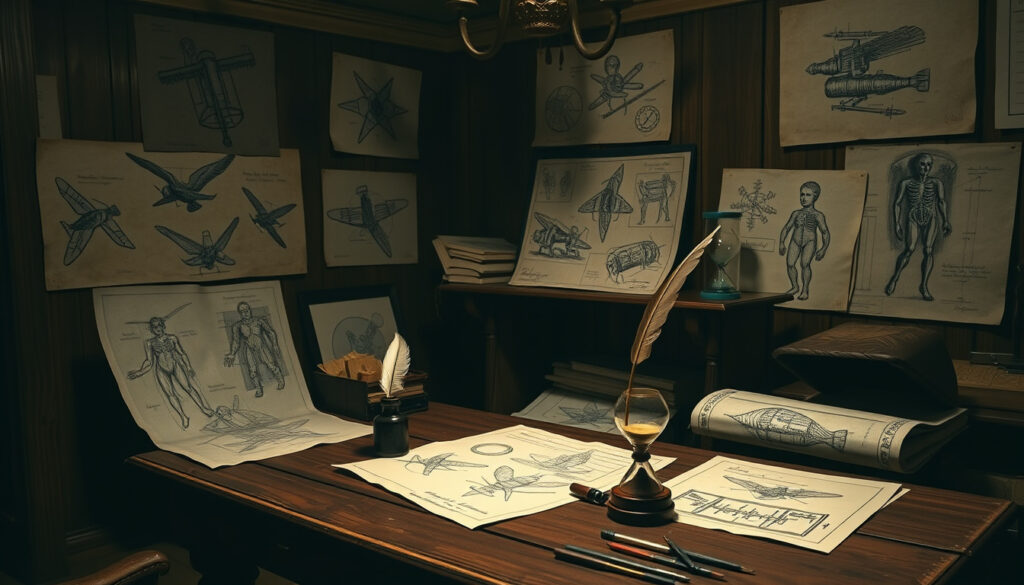
Beyond painting, Leonardo filled thousands of pages with anatomical drawings, mechanical designs, and studies of water flow. His notebooks — over 7,200 pages survive today according to the British Library — reveal a mind constantly testing ideas: flying machines, war engines, and detailed human dissections (Encyclopaedia Britannica).
Leonardo’s fame rests not on a single masterpiece but on being the model for the Renaissance ideal. His versatility means that when we ask about his death or disability, we’re examining a figure whose identity was never limited to one role.
The implication: “Renaissance man” isn’t a compliment — it’s a job description he wrote himself.
What are 5 facts about da Vinci?
Fact 1: He was a prolific note-taker
Leonardo kept thousands of pages of notes and sketches, covering everything from human anatomy to hydraulic engineering (British Library).
Fact 2: He studied human anatomy in detail
He performed human dissections to study anatomy, producing some of the earliest accurate drawings of the human body.
Fact 3: He designed flying machines
He sketched designs for a flying machine and a helicopter-like device, centuries before powered flight.
Fact 4: The Mona Lisa has no eyebrows
The Mona Lisa famously appears to have no eyebrows, a detail that has sparked centuries of speculation (Louvre Museum).
Fact 5: He was left-handed
He was left-handed and wrote in mirror script, a habit that has fascinated historians (National Gallery, London).
The pattern: these facts share a theme — Leonardo was never content with one discipline.
What caused da Vinci’s death?
Historical accounts of his final days
Leonardo da Vinci died on May 2, 1519, at Clos Lucé in France (Encyclopaedia Britannica). Contemporary accounts mention a long illness, but the immediate cause of death is not reliably documented in surviving records (Encyclopaedia Britannica).
Medical hypothesis: right hand palsy and stroke
A leading hypothesis comes from a 2019 study in the Journal of the Royal Society of Medicine (PMC) by Dr. Carlos Lázaro and Dr. Diego Lázaro. They argue that Leonardo’s right-hand impairment is better explained by ulnar palsy than by stroke, based on analysis of a 16th-century drawing of his hand. However, the same article states that an acute cardiovascular event could still have been the cause of death even if the hand impairment had a different cause (Journal of the Royal Society of Medicine (PMC)).
A 2020 commentary in PubMed Central disputes the ulnar-palsy reading, arguing the same drawing shows a hand posture consistent with median nerve injury instead. Two peer-reviewed interpretations of the same evidence.
What this means: after 500 years, medical experts can’t agree on how Leonardo lost the ability to paint — and they may never reach consensus.
For a deeper analysis, see our article on Leonardo da Vinci’s death and medical history.
What disability did Leonardo da Vinci have?
The right hand palsy diagnosis
Leonardo da Vinci suffered from right hand palsy in his later years (Journal of the Royal Society of Medicine (PMC)). The key historical source is the 1517 visit by Antonio de Beatis, who noted that Leonardo’s right hand was impaired but that he was left-handed and could still draw (National Gallery, London).
How it affected his later work
Despite the palsy, Leonardo continued to teach and draw (National Geographic Historia). The National Gallery states that a stroke may have left him paralyzed down the right side of his body (National Gallery, London), but this is disputed by the 2019 PMC study, which notes that the depicted hand posture does not resemble the clenched hand typical of post-stroke spasticity (Journal of the Royal Society of Medicine (PMC)).
The trade-off: the medical debate matters because it changes how we interpret his final years — was he a stroke victim or a man with a nerve injury who still produced?
Explore the debate: Did Leonardo da Vinci die of a stroke?
Did da Vinci have a child?
No confirmed biological children
Historians have found no credible evidence that Leonardo da Vinci had any biological children (Encyclopaedia Britannica).
His close relationship with Francesco Melzi
He had a close bond with his pupil Francesco Melzi, who became his heir (Encyclopaedia Britannica). Speculation about a child from his relationship with Cecilia Gallerani is unproven.
The implication: his legacy was passed through his art and his pupils, not through blood.
What did da Vinci say before he died?
The attributed last words
Leonardo da Vinci’s reported last words: “I have offended God and mankind because my work did not reach the quality it should have.” The quote appears in Giorgio Vasari’s Lives of the Most Excellent Painters, Sculptors, and Architects (1550).
Historical reliability of the quote
Historians debate the accuracy of Vasari’s account, as it was written decades after Leonardo’s death (Encyclopaedia Britannica). King Francis I of France was reportedly present at Leonardo’s deathbed and described him as a great philosopher, but no record of the last words exists from contemporary witnesses.
The catch: we may never know what Leonardo actually said, but the quote tells us more about how he wanted to be remembered than any medical report could.
Did da Vinci have ADHD?
Modern retrospective hypothesis
Some modern researchers have suggested Leonardo da Vinci may have had ADHD based on his constant shifting between projects (Brain journal (PubMed Central)). A 2019 study in the journal Brain proposed ADHD as an explanation for his procrastination and restlessness.
Evidence from his work habits
This is a retrospective diagnosis; no contemporary records state he had the condition (Encyclopaedia Britannica). The 2019 study notes that Leonardo’s pattern of leaving works unfinished and hopping between disciplines is consistent with ADHD traits.
The trade-off: diagnostic labels 500 years after death are inherently speculative, but they offer a humanizing lens — one that explains his endless curiosity without diminishing his achievements.
Timeline
- 1452: Born in Anchiano, near Vinci, Italy (Encyclopaedia Britannica).
- 1466: Apprenticed to artist Andrea del Verrocchio in Florence (Encyclopaedia Britannica).
- 1482-1499: Works in Milan for Ludovico Sforza; paints The Last Supper (Encyclopaedia Britannica).
- 1503: Begins painting the Mona Lisa (Encyclopaedia Britannica).
- 1516: Moves to France under patronage of King Francis I (Encyclopaedia Britannica).
- 1517: Suffers right hand palsy; can no longer paint (National Gallery, London).
- 1519: Dies at Clos Lucé, Amboise, France (Encyclopaedia Britannica).
The timeline shows a clear arc: 64 years of relentless creation, then two years of enforced stillness. For a man defined by movement and invention, the paralysis was not just physical.
The timeline confirms that Leonardo’s final years were marked by a sharp decline in his ability to paint.
Confirmed facts and open questions
Confirmed facts
- Leonardo da Vinci was an Italian Renaissance polymath (Encyclopaedia Britannica).
- He painted the Mona Lisa and The Last Supper (National Gallery, London).
- He died on May 2, 1519 (Encyclopaedia Britannica).
- He suffered from right hand palsy in his final years (Journal of the Royal Society of Medicine (PMC)).
What remains unclear
- Exact cause of death (stroke vs. other illness) (Encyclopaedia Britannica).
- Authenticity of the last words attributed by Vasari (Encyclopaedia Britannica).
- Whether he had ADHD (retrospective hypothesis only) (Brain journal (PubMed Central)).
- Moral judgment on his actions is subjective and debated (Encyclopaedia Britannica).
“I have offended God and mankind because my work did not reach the quality it should have.” — attributed to Leonardo da Vinci by Giorgio Vasari in Lives of the Most Excellent Painters, Sculptors, and Architects (1550)
King Francis I described Leonardo as a great philosopher and was reportedly present at his deathbed. — Contemporary account, recorded by Vasari
For readers looking to understand Leonardo’s final years, the choice is clear: accept the uncertainty of retrospective medical diagnoses, or settle for the incomplete but honest story — a genius who lost the ability to paint but never stopped creating.
rsm.ac.uk, en.wikipedia.org, newyorkhandandnerve.com, nicofranz.art, vault.nimc.gov.ng, nicofranz.art, node2.wickedlocal.com
For a broader overview of his life and legacy, you can read more about Leonardo da Vincis life and legacy.
Frequently Asked Questions
What is Leonardo da Vinci’s most famous painting?
The Mona Lisa, housed at the Louvre Museum in Paris, is his most famous work.
How many complete paintings did Leonardo da Vinci leave?
Fewer than 20 attributed paintings survive, with some disputed.
Did Leonardo da Vinci build his inventions?
Most of his inventions remained as sketches and notes; few were built in his lifetime.
Why is Leonardo da Vinci called the ‘Renaissance man’?
He excelled in multiple disciplines — art, science, engineering, and anatomy — embodying the Renaissance ideal of universal knowledge.
Where is the Mona Lisa displayed?
At the Louvre Museum in Paris, France.
How long did it take to paint the Mona Lisa?
Leonardo worked on it intermittently from around 1503 until 1519.
What did Leonardo da Vinci study in anatomy?
He performed human dissections and produced detailed anatomical drawings, including studies of the heart, muscles, and skeleton.
More related posts
 Ramada Resort by Wyndham Side – Reviews, Pools & Family Tips
 Silver Price in India – Live Rates Per Gram, KG and Cities
 Shang-Chi and the Legend of the Ten Rings Sequel News
 Lash Extensions Near Me: Prices, Salons & Care in Ireland
 Michael Clarke Duncan: Life, Death, Height, and Legacy
 Charles II: The Restoration King and the Inbred Spanish Monarch
 Best Films on Prime Video: Critic and User Top Picks
 Plenty of Fish Login Guide: Web, App & Troubleshooting
