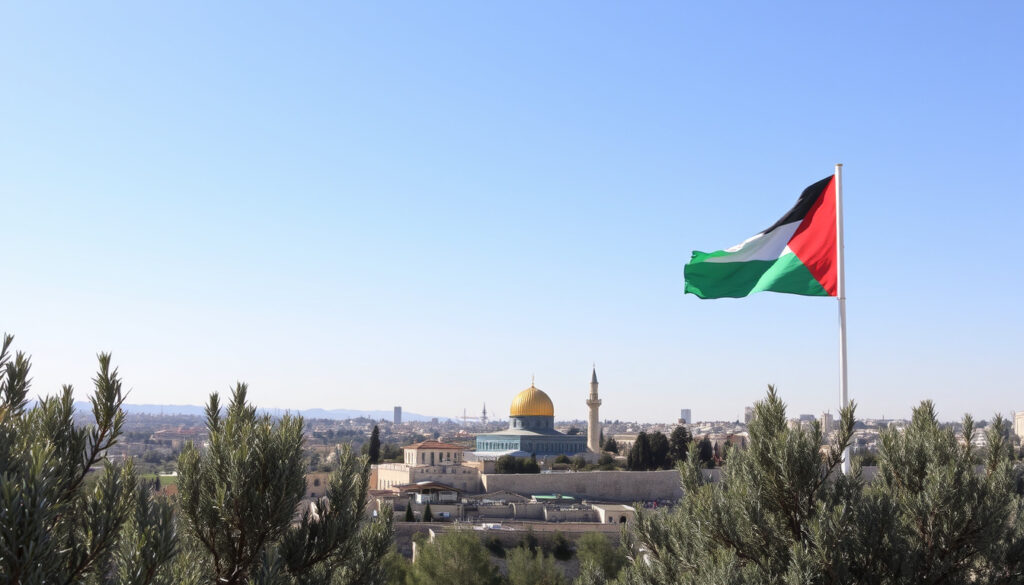
Is Palestine a Country? Status, Recognition, and History
Few questions in geopolitics are as deceptively simple as asking whether Palestine is a country, because the answer depends on who you ask. The State of Palestine declared independence on 15 November 1988 (Encyclopaedia Britannica), and as of September 2025, 156 UN member states have recognized it, yet its status at the United Nations remains that of a non-member observer state (United Nations UNISPAL).
UN Status: Non-member observer state (UN official status) ·
Recognizing UN Member States: 156 as of Sept 2025 (CFR) ·
Declaration of Statehood: 15 November 1988 (Britannica) ·
Area: 6,020 sq km (Palestinian Authority) ·
Population: Approx. 5.3 million (2023, Palestinian Authority)
Quick snapshot
- Independence proclaimed 15 November 1988 (Britannica)
- Recognized by 156 UN member states (CFR)
- UN status: non-member observer state (UN)
- Whether Palestine meets the fourth Montevideo criterion (OAS) – capacity for foreign relations – under occupation
- Full sovereignty over borders and East Jerusalem remains unresolved (Britannica)
- Future recognition patterns could shift with new UN votes (UN)
- 1948 (Britannica): State of Israel declared; no Palestinian state
- 1988 (Britannica): PLO proclaims State of Palestine
- 2012 (CFR): UN General Assembly grants non-member observer status
- 2024-25 (Britannica): New wave of recognitions by Spain, Norway, Ireland, and others
- More EU countries likely to recognize in 2025–2026 (UN high‑level conference)
- UN Security Council may revisit full membership bid (US veto expected) (CFR)
- International Court of Justice ruled occupation unlawful (July 2024)
The table below summarizes key facts about the State of Palestine with authoritative sources.
| Attribute | Value | Source |
|---|---|---|
| Official name | State of Palestine | Britannica |
| Claimed capital | East Jerusalem | Palestinian Authority |
| Government | Palestinian Authority (West Bank) / Hamas (Gaza) | CFR |
| UN status | Non-member observer state | United Nations |
| Area | 6,020 sq km | Palestinian Authority |
| Population (2023) | Approx. 5.3 million | Palestinian Authority |
| Recognition (2025) | 156 UN member states | CFR |
Is Palestine technically a country?
What are the criteria for statehood under the Montevideo Convention?
The Montevideo Convention of 1933 (Organization of American States) is the most widely accepted legal benchmark for statehood. It sets four criteria: a permanent population, a defined territory, a functioning government, and the capacity to enter into relations with other states. These criteria are not always applied uniformly – political recognition often overrides technical checklists.
Does Palestine meet the Montevideo criteria?
Palestine satisfies three of the four criteria without much dispute. It has a permanent population of roughly 5.3 million (Palestinian Authority), a defined territory comprising the West Bank and Gaza Strip (6,020 sq km per Britannica), and a government – the Palestinian Authority administers the West Bank while Hamas governs Gaza. The fourth criterion, however, is problematic: because Israel controls borders, airspace, and trade, Palestine’s capacity to conduct independent foreign relations is severely limited (Council on Foreign Relations).
Most legal scholars agree that Palestine qualifies as a state under the declarative theory (Montevideo), but the constitutive theory – which requires recognition by other states – remains politically divided. The gap between legal definition and diplomatic reality is exactly where the debate lives.
The implication: Palestine is technically a state by the Montevideo criteria, but the fourth criterion’s weakness gives opponents a legal – not just political – reason to withhold recognition.
Is Palestine recognized as a country?
Which countries recognize Palestine as a state?
As of September 2025, 156 of the 193 UN member states recognise the State of Palestine (Council on Foreign Relations). The recognisers include most of Asia, Africa, and Latin America, plus a growing number of European countries. In May 2024, Spain, Ireland, and Norway formally recognized Palestine (Britannica), and by mid-2025 several more EU states followed, including France and Belgium. The UN General Assembly vote on 29 November 2012 that upgraded Palestine to non-member observer state passed with 138 votes in favour, only 9 against.
Why does the United States not recognize Palestine?
The United States does not recognise Palestine as a sovereign state and has vetoed its full UN membership bid in the Security Council (CFR). US policy insists that Palestinian statehood must result from direct negotiations with Israel, not unilateral declarations. This stance has remained consistent across both Democratic and Republican administrations, although specific policies – like moving the US embassy to Jerusalem – have varied.
Without US backing, Palestine cannot gain full UN membership. The US veto means the Security Council route is blocked, leaving Palestine reliant on General Assembly resolutions that are non-binding. For Palestinians, the result is a statehood that exists in law and in most of the world’s view, but is frozen at the UN gate.
What this means: recognition is now the norm, not the exception. Yet the holdouts – especially the US, UK, Germany, and a few others – represent the countries with the most diplomatic weight. That asymmetry keeps Palestine in a state of semi-recognition.
Are Palestine and Israel a country?
How does the international recognition of Israel compare to that of Palestine?
Israel is a full UN member state (United Nations) recognised by 165 of 193 member states. That number is actually slightly higher than Palestine’s 156, but more importantly Israel enjoys full diplomatic relations with most major powers and holds a seat in the General Assembly with voting rights. Its borders are internationally contested – especially regarding settlements and East Jerusalem – but no major power questions its status as a sovereign state.
Is Israel a country under the same definition as Palestine?
Both Israel and Palestine meet the Montevideo criteria on paper. The key difference lies in the fourth criterion: Israel exercises full control over its borders, airspace, and foreign policy. Palestine does not. The Montevideo Convention (OAS) treats capacity for foreign relations as a practical matter – and by that measure, Palestine falls short. The result is that Israel is unquestionably a state in both legal and diplomatic terms, while Palestine is a state in legal terms but disputed diplomatically.
The trade-off: if you use the declarative definition, both are countries. If you require practical sovereignty, only Israel qualifies. That is not a judgement on legitimacy – it is a reflection of the power asymmetry that defines the conflict.
The table below compares Palestine and Israel against the four Montevideo criteria for statehood.
| Criterion | Palestine | Israel |
|---|---|---|
| Permanent population | Yes (~5.3 million) | Yes (~9.7 million) |
| Defined territory | Yes (West Bank & Gaza, 6,020 sq km) | Yes (22,072 sq km, borders disputed) |
| Functioning government | Yes (PA & Hamas, but divided) | Yes (unified central government) |
| Capacity for foreign relations | No (limited by occupation) | Yes (full sovereignty) |
Does Palestine exist before Israel?
What was the region called before 1948?
The area was known as Palestine historically – the name dates to Roman times – but it was not an independent state. The League of Nations granted Britain a mandate over Palestine in 1922 (United Nations), and the territory was administered as a single unit until the UN Partition Plan of 1947 (UN) proposed dividing it into Arab and Jewish states. The State of Israel was proclaimed on . No Arab Palestinian state was created at that time.
When was the modern State of Palestine established?
The Palestine Liberation Organization proclaimed the State of Palestine on 15 November 1988 (Britannica), four decades after Israel’s founding. The first country to recognise it was Algeria. So no, Palestine as a modern state does not predate Israel – the historical region called Palestine existed, but the political entity called the State of Palestine was declared in 1988.
The pattern: the region’s name is ancient, but the state is recent. That distinction matters because arguments about “first existence” often conflate a place name with a sovereign entity. The chronological record is clear: Israel became a state in 1948, Palestine in 1988.
Why is Palestine not recognized as a country?
What political obstacles prevent full recognition?
The primary obstacle is the US veto at the UN Security Council (CFR), which blocks full membership. Additionally, the Oslo Accords (Britannica) left final status issues unresolved – borders, Jerusalem, security, and refugees – meaning no internationally agreed territory exists. Internal Palestinian divisions between the Palestinian Authority in the West Bank and Hamas in Gaza also weaken the claim to a unified government.
How does the Israeli occupation affect Palestine’s statehood?
Israel’s occupation of the West Bank and East Jerusalem since 1967 (UN) means Palestine lacks effective control over its claimed borders, airspace, and trade routes. The International Court of Justice in July 2024 (ICJ) ruled the occupation unlawful, but that advisory opinion does not change the de facto situation. Without territorial control, the Montevideo criterion of “capacity to enter relations with other states” is undermined – a state that cannot control its own borders is not fully sovereign.
The catch: recognition is both a legal and a political act. Palestine has the legal attributes of a state, but the political reality of occupation means many countries that recognise it still cannot treat it as a fully sovereign partner. The gap between recognition and sovereignty is the defining feature of Palestine’s status today.
Timeline: Palestine’s path to statehood
- : Balfour Declaration expresses British support for a Jewish homeland in Palestine (Britannica)
- : League of Nations grants Britain mandate over Palestine (UN)
- : UN Partition Plan proposes Arab and Jewish states (CFR)
- : State of Israel declared; first Arab-Israeli war; no Palestinian state (Britannica)
- : Six-Day War; Israel occupies West Bank, Gaza, East Jerusalem (Britannica)
- : PLO declares State of Palestine; Algeria first to recognize (Britannica)
- : UN General Assembly grants Palestine non-member observer state status (CFR)
- : Spain, Ireland, and Norway formally recognize Palestine (Britannica)
- : ICJ rules Israeli occupation unlawful (ICJ)
- : 156 UN members recognize Palestine; 10 more announce recognition at resumed conference (UN)
Clarity check
Confirmed facts
- Palestine is a UN non-member observer state (since 2012).
- 156 UN member states recognise the State of Palestine (as of Sept 2025).
- Palestine meets three of four Montevideo criteria for statehood.
- The State of Palestine was proclaimed on 15 November 1988.
What’s unclear
- Whether Palestine qualifies as a “country” depends on legal vs political definitions.
- Full sovereignty over borders and East Jerusalem remains unresolved.
- Future recognition patterns may shift with new UN votes or peace talks.
Expert perspectives
“Palestine is a state that does and does not exist.”
“Palestine, officially the State of Palestine, is a country in West Asia.”
“Palestine was among former Ottoman territories placed under UK administration by the League of Nations in 1922.”
United Nations UNISPAL (historical record)
Frequently asked questions
Is Palestine a member of the United Nations?
No. Palestine is a non-member observer state. It can participate in General Assembly debates but cannot vote. Full membership requires a Security Council recommendation (which the US has vetoed) and a two-thirds General Assembly vote.
Can Palestinians travel with a Palestinian passport?
Yes. Palestinian Authority-issued passports are recognised by many countries, though holders face visa restrictions because the passport is not backed by a fully sovereign state. Travel into and out of Palestinian territories is controlled by Israel.
What is the capital of Palestine?
The State of Palestine claims East Jerusalem as its capital. However, Israel controls East Jerusalem and considers Jerusalem its undivided capital. Most foreign embassies are in Tel Aviv.
Does Palestine have an army?
No. The Palestinian Authority has security forces but no military. Under the Oslo Accords, Palestine is not permitted to have an army. Security is coordinated with Israel in parts of the West Bank; Gaza is governed by Hamas separately.
Is Gaza part of Palestine?
Yes. Gaza is part of the territory claimed by the State of Palestine. Since 2007 it has been governed by Hamas, while the Palestinian Authority remains the internationally recognised government for the whole territory.
What is the difference between Palestine and the Palestinian Authority?
Palestine is the sovereign state (in theory). The Palestinian Authority (PA) is the administrative government that exercises limited self-rule in parts of the West Bank. The PA was created by the Oslo Accords and is not a full government for a sovereign state.
How many countries recognise Palestine?
As of September 2025, 156 UN member states recognise the State of Palestine (CFR). That number is growing, with 10 more countries announcing recognition in September 2025.
Is Palestine a country according to international law?
Most legal experts say yes, under the declarative theory of statehood (Montevideo Convention). However, international law is not a single answer – it depends on which court or treaty you use. The ICJ has not ruled on Palestine’s statehood directly, but its 2024 advisory opinion on the occupation implicitly treats Palestine as a state entitled to self-determination.
More related posts
 Kia Sorento for Sale in Ireland: Best Years to Buy (2025)
 Toyota Yaris for Sale in Ireland: Used & New Deals
 A1(M) Motorway Explained: Meaning and Differences from A1 & M1
 Prince Edward, Duke of Kent: Biography, Age & Succession
 Turkish Lira to Pound: Live Rate & Conversion Guide
 What Is Sertraline Used For – Dosage, Side Effects and More
 What Is a Millennial? Definition, Age Range, and Key Traits
 Cast of Wayne’s World – Actors, Roles and Cameos
