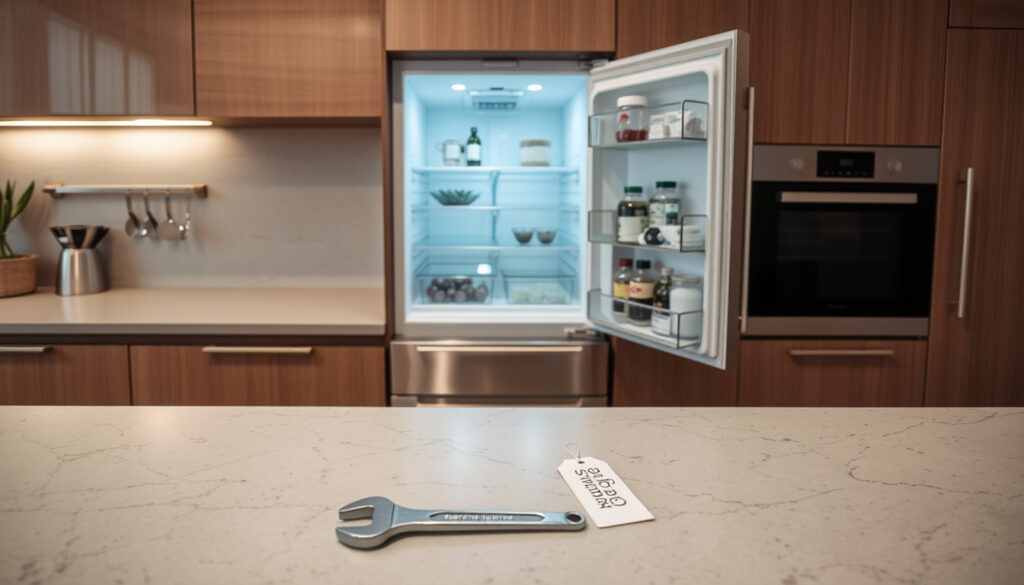
Integrated Fridge Freezer Guide: Lifespan, Costs & Repair
Few kitchen decisions hide their trade-offs quite like the integrated fridge freezer: it disappears into the cabinets, and the real costs only show up when something stops cooling. The lifespan typically lands between 10 and 15 years, and repairs run anywhere from a £60 thermostat to a £480 compressor, per Beko Ireland (manufacturer repair guidance) — a spread that explains why the smart move here is sometimes a service visit, sometimes a straight-swap replacement, and sometimes just measuring the cupboard before you order anything.
Typical lifespan: 10–15 years · Most common failure: Compressor or cooling system · Most expensive repair: Compressor/sealed-system replacement · Common size splits: 50/50, 60/40 and 70/30 · Straight-swap fitting: Usually under a day
- Compressor replacement is the costliest common repair at $700–$1,250 (HomeGuide (home-services cost research)).
- Fridge repairs average $300–$500, and appliance fixes span $80–$900 (ConsumerAffairs (consumer research platform)).
- Technicians typically charge $45–$120 per hour plus a $150–$200 service fee (HomeAdvisor (US home-services cost data)).
- Exact repair costs swing widely — Angi’s average fridge repair of $200–$300 sits inside a wider $40–$350 range (Angi (home-services cost data)).
- Freezer repairs are just as variable, with ConsumerAffairs reporting $200–$800 (ConsumerAffairs (consumer research platform)).
- Built-in fridge-freezers are almost always cheaper to repair than replace for ordinary faults (Inch Calculator (appliance repair cost guide)).
- Get an itemised fitting quote — installed refrigerator cost runs $650–$4,250 including the appliance (HomeAdvisor (US home-services cost data)).
- If the repair quote tops 50% of a new unit’s price, book the swap rather than the service visit.
| Common size splits | 50/50, 60/40, 70/30, plus some 80/20 models. |
| Typical lifespan | Around 10–15 years. |
| Most expensive repair | Compressor or sealed-system replacement. |
| Cheaper common repairs | Thermostat £60–£130; ice maker £70–£420; defrost timer £80–£165. |
Editor’s note: Repair and installation prices are published benchmarks from manufacturer and consumer-service sources.
That table is the economic story in miniature: the sealed system is the line between a repair and a replacement, and everything else is usually fixable.
A badly ventilated integrated unit doesn’t just undercool — it shortens the life of the most expensive part in the machine.
What’s the typical lifespan of an integrated fridge freezer?
A typical integrated fridge freezer lasts 10–15 years, with usage, maintenance, build quality and kitchen temperature all moving that number.
- Apply the 50% rule: if the repair quote is more than half the price of a comparable new appliance, replacement is the usual recommendation (Beko Ireland (manufacturer repair guidance)).
- Inch Calculator (appliance repair cost guide).
The most common failure points are the compressor, condenser fan, thermostat, start relay, door seals and drain lines — and the cost of the fix varies by a factor of ten between the cheapest and most expensive.
- Compressor or sealed-system replacement: $700–$1,250 (HomeGuide (home-services cost research)), with manufacturer guidance putting the UK/Irish equivalent at roughly £300–£480 (Beko Ireland (manufacturer repair guidance)).
- General refrigerator repair: $300–$1,000 (HomeAdvisor (US home-services cost data)), with many jobs landing at $200–$500 (Fixr (home-improvement cost estimator)).
- Freezer repair: $200–$800 (ConsumerAffairs (consumer research platform)).
- Evaporator fan motor: $200–$650 (Inch Calculator (appliance repair cost guide)).
The labour line, not the part, is where a thermostat visit can cost more than the part itself.
A compressor failure on an integrated unit is the point where repair stops being a repair and starts being a down payment on a replacement.
The pattern: anything that breaches the sealed system costs nearly as much as a new appliance, and everything else is usually worth fixing.
Integrated fridge freezers: pros and cons that affect real decisions
How to replace an integrated fridge freezer: a straight-swap checklist
- Average refrigerator repair runs $200–$300, within a wider range of $40–$350 (Angi (home-services cost data)).
- Freezer repairs average $100–$400 (HomeGuide (home-services cost research)).
- Refrigerator repairs typically land between $200 and $500 depending on the problem (Fixr (home-improvement cost estimator)).
An integrated fridge freezer is a piece of the kitchen before it’s an appliance, and that changes the repair logic. For a UK household facing a cooling failure today, the decision is clear: weigh any repair quote against half the cost of a like-for-like replacement, and if the old unit predates current energy ratings, let the replacement win.
What is the best split for an integrated fridge freezer: 50/50, 60/40 or 70/30?
There is no universal best split.
Do integrated fridge freezers need ventilation gaps?
Yes. If the opening, hinge and ventilation line up, the swap is a straight one.
homeadvisor.com, homeguide.com, angi.com, fixr.com, cinchhomeservices.com, airtasker.com, thumbtack.com
More related posts
 Prince Edward, Duke of Kent: Biography, Age & Succession
 Christina Aguilera: Kids, Ethnicity, Feuds & Life Now
 Jimmy Nail 2026: Bio, Wife, Net Worth, Songs & More
 Knee High Black Boots Ireland: Where to Buy, Style & Fit
 What Does Empathy Mean – Definition, Types and Examples
 What Is Sertraline Used For – Dosage, Side Effects and More
 Best Trainers for Walking – Top 2025 UK Tested Picks
 Camila Mendes Biography: Age, Height, Relationships & Movies
