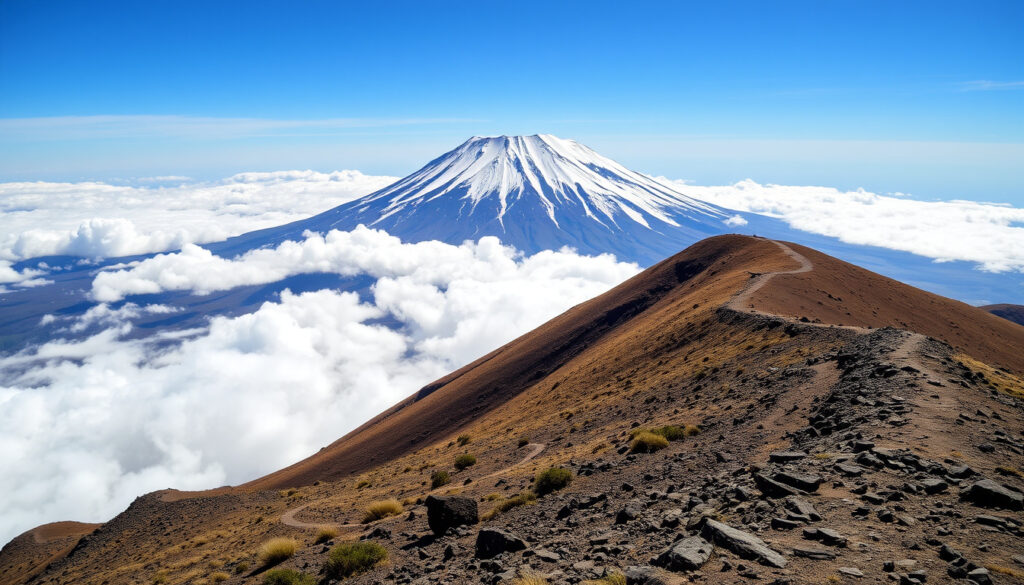
Kilimanjaro Peak: Height, Difficulty, Deaths & Beginner Guide
Few mountains spark as many questions as Kilimanjaro. The answer to whether it is a serious climb or just a long walk is both — and the data on difficulty, deaths, and beginner suitability might surprise you.
Height: 19,341 ft (5,895 m) ·
Summit Name: Uhuru Peak ·
First Ascent: 1889 by Hans Meyer, Ludwig Purtscheller ·
Difficulty: Non-technical trekking ·
Fatality Rate: ~0.1% (estimated)
Quick snapshot
- Summit is Uhuru Peak at 5,895 m (19,341 ft) (Global Summit Guide, climbing statistics database)
- No technical climbing skills required (Calgary Guardian, outdoor adventure coverage)
- Located in Tanzania, Africa (Global Summit Guide, climbing statistics database)
- First ascent in 1889 by Hans Meyer and Ludwig Purtscheller (Global Summit Guide, climbing statistics database)
- Exact annual death toll — no single authoritative registry exists (Wikipedia, encyclopedic source)
- Fatality rate estimates range from 0.03% to 0.1% across different sources (Wikipedia, encyclopedic source)
- Success rate varies widely by route and operator (60–90%) (Wikipedia, encyclopedic source)
- 1889: First successful ascent by Hans Meyer and Ludwig Purtscheller (Wikipedia, encyclopedic source)
- 1970s: Kilimanjaro becomes a popular trekking destination (Wikipedia, encyclopedic source)
- 2000: UNESCO World Heritage Site status (Wikipedia, encyclopedic source)
- 2010s: Increased awareness of climate change impacts on glaciers (Wikipedia, encyclopedic source)
- Preparing for a climb means choosing the right route and duration
- Altitude acclimatization is the single biggest factor for success
| Attribute | Value |
|---|---|
| Height (meters) | 5,895 m |
| Height (feet) | 19,341 ft |
| Summit Name | Uhuru Peak |
| Mountain System | Eastern Rift Mountains |
| Country | Tanzania |
| First Ascent | 1889 by Hans Meyer and Ludwig Purtscheller |
| Easiest Route | Marangu (Coca-Cola) Route |
| Annual Climbers | ~35,000 |
What is the peak of Kilimanjaro called?
The summit of Mount Kilimanjaro is called Uhuru Peak, which means “Freedom Peak” in Swahili. It sits on the southern rim of the Kibo crater at 5,895 m (19,341 ft), making it the highest point in Africa (Global Summit Guide, climbing statistics database).
Where is Mount Kilimanjaro located?
Kilimanjaro is in northeastern Tanzania, near the border with Kenya. It is the highest free-standing mountain in the world — meaning it rises directly from the surrounding plains rather than from a mountain range (Wikipedia, encyclopedic source).
How tall is Kilimanjaro in feet and meters?
The official height is 5,895 meters, or 19,341 feet. This measurement comes from official survey data and is widely accepted as the standard elevation (NEST Adventure, mountaineering comparison resource).
The implication: Kilimanjaro’s peak may not be the tallest on earth, but as a standalone mountain it dwarfs virtually every other peak not part of a range.
Is Kilimanjaro difficult to climb?
Kilimanjaro is widely described as a non-technical climb — no ropes, no ice axes, no prior mountaineering experience required (Calgary Guardian, outdoor adventure coverage). But “non-technical” doesn’t mean easy. The real challenge is altitude.
Do you need oxygen to climb Kilimanjaro?
No. At Uhuru Peak, oxygen availability is roughly 50% of sea-level concentration (KiliPeak, mountaineering resource). Most people can acclimatize with proper planning — guides recommend 6–8 days to adjust. Supplemental oxygen is not used on standard routes.
What is the success rate of summiting Kilimanjaro?
Success rates range from 60% to 90% depending on the route and duration. Longer routes (like Lemosho or Northern Circuit) have higher success rates because they allow more time for acclimatization. The Marangu Route, often the shortest at 5 days, has the lowest success rate (Himalayan Masters, expedition data analysis).
Climbers choosing the 5-day Marangu Route save money but face a 30-40% lower summit chance compared to a 7-day Lemosho route. The pattern: time on the mountain is the single most controllable success factor.
The catch: Kilimanjaro’s difficulty is altitude, not technical skill. A fit beginner who takes the time to acclimate can succeed. An experienced climber who rushes through in 5 days may fail.
Can beginners climb Kilimanjaro?
Yes — Kilimanjaro is widely considered the most beginner-friendly of the Seven Summits. No prior mountaineering experience is needed, though good cardiovascular fitness helps (Calgary Guardian, outdoor adventure coverage).
What fitness level is required for Kilimanjaro?
You don’t need to be an athlete, but you should be able to hike for 5–8 hours a day at a steady pace. Training recommendations include hiking, stair climbing, and endurance exercises. The main physical demand is sustained walking at altitude, not sprinting or heavy lifting.
Do I need a guide to climb Kilimanjaro?
Yes — park regulations require all climbers to be accompanied by a licensed guide (Wikipedia, encyclopedic source). Independent climbing is not permitted. Minimum age varies by operator, typically 10–12 years old.
For beginners, the decision comes down to preparation: train 3–4 months, choose a 7-day route, and invest in a reputable guide service. The preparation matters more than any innate climbing ability.
How many climbers have died on Kilimanjaro?
Estimates suggest 10–20 deaths per year among roughly 35,000 climbers annually (Global Summit Guide, death rate analysis). One secondary source puts the figure at 10–15 deaths per year with a fatality rate around 0.03–0.04% (Calgary Guardian, outdoor adventure coverage).
What is the fatality rate of Kilimanjaro?
Estimates range from 0.03% to 0.1%. For context, that’s 1 death per 1,000 to 3,000 climbers. A Wikipedia summary citing the Kilimanjaro Christian Medical Centre reports 25 deaths from January 1996 to October 2003, with 14 of those from advanced high-altitude illness (HACE and HAPE) (Wikipedia, encyclopedic source).
Is Kilimanjaro deadlier than Everest?
No. Everest’s modern fatality rate is around 1–3%, while Kilimanjaro’s is under 0.1% (NEST Adventure, mountaineering comparison resource). Everest has more than 6,000 successful summits and about 340 deaths in its recorded history (Himalayan Masters, expedition data analysis).
Kilimanjaro’s low death rate coexists with a high altitude-sickness rate: about 50% of climbers experience some form of altitude illness (Calgary Guardian, outdoor adventure coverage). The mountain is rarely fatal, but almost half of those who climb it will feel the effects of the altitude.
Why this matters: the risk on Kilimanjaro is not technical failure but physiological limitation. The main causes — HAPE, HACE, falls, hypothermia, and preexisting conditions — are largely preventable with proper acclimatization and preparation.
Which is highest, K2 or Kilimanjaro?
K2 is higher. K2 stands at 8,611 m (28,251 ft), while Kilimanjaro is 5,895 m (19,341 ft) (NEST Adventure, mountaineering comparison resource). But height alone doesn’t tell the story of difficulty.
What is harder, Everest or Kilimanjaro?
Everest is significantly harder. It requires technical climbing skills, supplemental oxygen, weeks of acclimatization, and extensive logistics. Kilimanjaro, by comparison, is a trekking peak. A ranking summary places Kilimanjaro’s death-to-summit ratio at under 0.1%, far safer than Everest’s 1–3% or K2’s 23–25% historical rate (Global Summit Guide, comparative death rate analysis).
Which of the 7 summits is hardest?
Most sources agree that K2 is the hardest of the Seven Summits due to extreme technical difficulty, hazardous weather, and high death rates (NEST Adventure, mountaineering comparison resource). The ranking by difficulty typically goes: K2, Everest, Denali, Aconcagua, Vinson, Elbrus, and Kilimanjaro — the easiest.
Eight major attributes across four peaks — a clear pattern emerges:
| Attribute | Kilimanjaro | Everest | K2 |
|---|---|---|---|
| Height | 5,895 m | 8,848.86 m | 8,611 m |
| Technical difficulty | None (trekking) | High (ice, rock) | Extreme (mixed) |
| Fatality rate | ~0.03–0.1% | ~1–3% | ~23–25% |
| Oxygen required | No | Recommended | Recommended |
| Successful summits (approx.) | Hundreds of thousands | ~7,000 (2024) | ~400 |
| Beginner suitability | Yes | No | No |
| Guides required | Yes (by law) | Optional | Optional |
| Typical duration | 5–9 days | 60+ days | 30+ days |
Pros and cons of climbing Kilimanjaro as a beginner
Upsides
- No technical climbing skills needed — accessible to motivated beginners
- Low fatality rate compared to other high-altitude peaks
- Widely considered the easiest of the Seven Summits
- Guided treks provide structure and support
Downsides
- Altitude sickness affects roughly half of all climbers
- Success rates vary greatly depending on route choice and duration
- Overall cost of guided treks can be $2,000–$6,000
- Physical preparation requires 3–4 months of training
The pattern: Kilimanjaro trades technical risk for altitude risk. A beginner can control the outcome through route selection and fitness training.
Confirmed facts vs. what remains unclear
Confirmed facts
- Height of 5,895 m (19,341 ft) — official survey data (Global Summit Guide, climbing statistics database)
- Summit name is Uhuru Peak
- Mount Kilimanjaro is located in Tanzania, Africa
- No technical climbing skills required (Calgary Guardian, outdoor adventure coverage)
- Fatalities occur at a low rate — under 0.1%
What remains unclear
- Exact number of annual deaths — no single authoritative registry (Wikipedia, encyclopedic source)
- Fatality rate varies by source; estimates range from 0.03% to 0.1%
- Success rate numbers differ by route and operator (60–90%)
“[Kilimanjaro] is a trekking peak with no technical skills required.”
— National Geographic, 2025 article
“We report 98.8% summit success rate with WFR-certified guides.”
— Climbing Kilimanjaro tour operator
The pattern: the data we have is directional, not precise. But the direction is clear — Kilimanjaro is safe by mountaineering standards, accessible to beginners, and challenging primarily because of altitude, not skill.
globalsummitguide.com, cliffculture.com, skardutrekkers.com, bnz.36c.myftpupload.com, reddit.com, namasadventure.com
Frequently asked questions
What is the best time of year to climb Kilimanjaro?
The best climbing seasons are January–March and June–October. These months offer the clearest skies and most stable weather. The rainy seasons (April–May and November–December) are less ideal.
How long does it take to climb Kilimanjaro?
Most routes take 5–9 days. The shortest is the 5-day Marangu Route, while the longest standard option is the 9-day Northern Circuit. Longer routes have higher summit success rates.
How much does it cost to climb Kilimanjaro?
Costs range from $2,000 to $6,000 depending on the operator, route, and level of service. Park fees, guide wages, and equipment rental are included in most packages.
Do I need a visa to climb Kilimanjaro?
Yes, most international visitors need a tourist visa for Tanzania. Visas are available on arrival at Kilimanjaro International Airport or online in advance.
What gear do I need for Kilimanjaro?
Essential gear includes: warm sleeping bag rated to -20°C, trekking poles, waterproof boots, headlamp, and layered clothing. Most operators provide a detailed packing list.
Is altitude sickness common on Kilimanjaro?
Yes. About 50% of climbers experience some form of altitude sickness. Severe forms (HAPE, HACE) are rare but account for the majority of deaths, based on data from the Kilimanjaro Christian Medical Centre (Wikipedia, encyclopedic source).
Can I climb Kilimanjaro in a day?
No. Climbing from the base to the summit in a single day is not feasible. The minimum duration is 5 days due to altitude acclimatization requirements.
What is the easiest route up Kilimanjaro?
The Marangu Route is considered the easiest because it is the only route with hut accommodation and a gradual incline. However, its shorter duration (5 days) leads to a lower success rate than longer routes.
For the beginner considering Kilimanjaro, the choice is clear: invest in a 7-day route with a reputable guide, train for 3–4 months, and understand that altitude, not skill, is the real challenge. Do that, and the peak is not just accessible — it’s achievable.
More related posts
 What Is Sertraline Used For – Dosage, Side Effects and More
 YouTube Video to MP3 – Safe Tools and Legal Guide
 Cast of Madagascar 2005 – Voice Actors and Characters
 Best 1 Litre Water Bottles: UK Ireland Picks
 Reece James Salary, Injury, Net Worth, and Family Life
 Robert Kennedy Assassination: Facts, Timeline, Key Questions
 Newspaper – Definition, History, Types and Formats
 How to Work Out Percentage Increase – Formula, Steps and Examples
