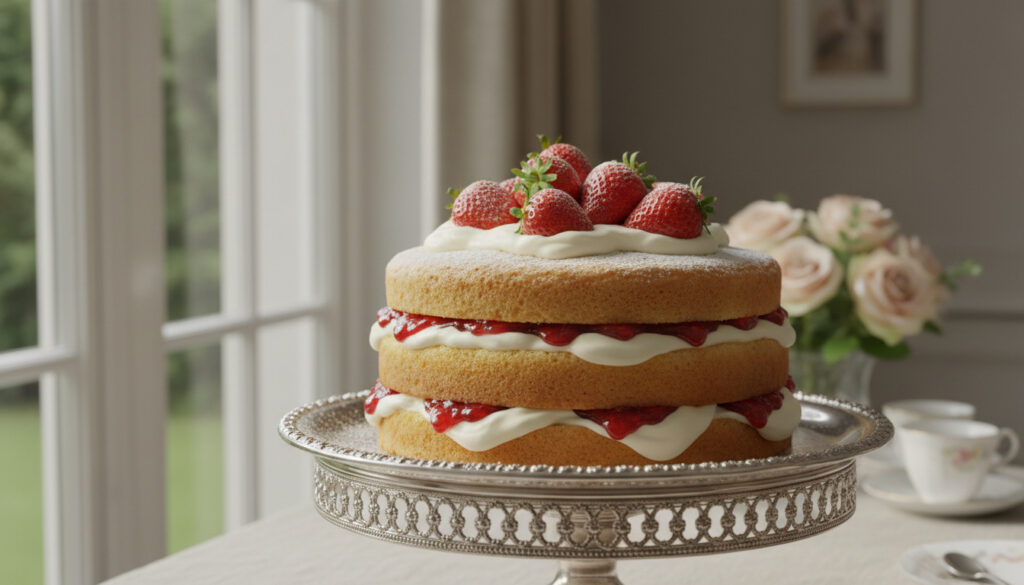
Mary Berry Victoria Sponge – Classic Recipe and Tips
Mary Berry’s Victoria sponge stands as the definitive British tea-time classic. The all-in-one method transforms equal weights of eggs, butter, sugar, and flour into a golden, springy cake that sandwiches raspberry jam and buttercream between two perfect layers.
The recipe emphasizes precision without complexity. Softened butter blends with caster sugar and self-raising flour at 180°C, creating the signature dropping consistency that characterizes Berry’s approach to this traditional bake.
Home bakers value this method for its reliability. The technique appears consistently across official Great British Bake Off resources and demonstrations, establishing the foundation for countless afternoon tea gatherings.
Mary Berry Victoria Sponge Tips
| Core Ingredients 4 large eggs, 225g each of butter, caster sugar, and self-raising flour |
Prep & Bake 20 minutes preparation, 25 minutes at 180°C/160°C fan |
| Filling Raspberry jam and buttercream between layers |
Yield Serves 8-10, easy difficulty level |
- Weigh eggs in their shells to determine precise quantities for perfect ratios
- Use caster sugar exclusively; granulated sugar creates a greasy sponge texture
- Soften butter overnight at room temperature rather than microwaving
- Mix all-in-one batter gently to avoid overworking and toughness
- Bake until golden and the sponge pulls slightly from tin edges
- Cool sponges 5-10 minutes in tins before turning out to prevent breakage
| Metric | Detail |
|---|---|
| Eggs | 4 large |
| Butter | 225g softened unsalted |
| Sugar | 225g caster |
| Flour | 225g self-raising |
| Baking Powder | 1 teaspoon |
| Oven Temperature | 180°C/350°F/Gas 4 |
| Tin Dimensions | Two 20cm sandwich tins |
| Baking Duration | 25 minutes |
Mary Berry Victoria Sponge with Buttercream and Cream
Classic Buttercream Filling
The traditional filling combines 100g softened butter beaten with 200g icing sugar and 2 tablespoons milk until creamy. This mixture pipes cleanly over the raspberry jam layer, creating the characteristic white ring visible when the cake is sliced.
Piping buttercream creates clean edges and even distribution. Spread jam first, pipe cream on top, then add the second sponge.
Alternative Cream Fillings
Variations substitute buttercream with 300ml whipped double cream or a stabilized mixture of cream cheese and whipping cream. Visual demonstrations emphasize piping these softer fillings to maintain control during assembly. Strawberry jam serves as a common alternative to raspberry.
Storage requirements change with the filling choice. Cakes with cream-based fillings require chilling, while buttercream versions remain stable at room temperature for short periods.
Mary Berry Victoria Sponge Chocolate, Oil, and Lemon Variations
Chocolate Adaptations
No direct Mary Berry chocolate Victoria sponge recipe appears in the examined official sources. Standard baking adaptations suggest replacing 25-50g of flour with cocoa powder, though this modification falls outside Berry’s verified recipe canon.
Oil Substitutions
Oil remains absent from Berry’s documented methods. Her technique relies specifically on softened butter for proper aeration and texture. BBC Food archives note that over-softening butter can lead to an eggy flavor, underscoring the importance of proper preparation.
Lemon Interpretations
Lemon-specific variations by Berry lack confirmation in current research. Common home adaptations include adding lemon zest to the batter or substituting lemon curd for the jam filling, though these represent creative departures rather than official guidance.
Mary Berry Victoria Sponge Video and YouTube Guides
Visual tutorials clarify techniques difficult to convey through text alone. Comprehensive demonstrations show the egg-weighing method, proper creaming consistency, and 165°C fan baking alternatives with cream cheese frosting assembly.
Video demonstrations reveal the proper “dropping consistency” of batter and the exact golden color to aim for when baking concludes.
Additional guides cover GBBO technical challenge recreations, showing precise piping methods and tin preparation techniques that prevent sticking.
Mini and Small Mary Berry Victoria Sponge
The GBBO Series 5 Final technical challenge featured a scaled version using 175g butter, 175g caster sugar, 3 eggs, 1 teaspoon vanilla, 175g flour, 2 teaspoons baking powder, and ½ teaspoon salt. Baked in mini tins, these petite sponges sandwich strawberry jam made from 500g hulled strawberries and 500g sugar, filled with whipped double cream rather than buttercream.
Recreation videos demonstrate the assembly of these individual portions, linking to PBS recipe archives for precise timing.
Mary Berry Victoria Sponge Baking Sequence
- : Preheat oven to 180°C/160°C fan and grease and line two 20cm sandwich tins
- : Combine eggs, sugar, flour, baking powder, and softened butter; mix to dropping consistency
- : Bake on middle shelf for 25 minutes until golden, springy, and pulling from edges
- : Rest in tins 5-10 minutes before turning out to wire racks
- Jam preparation: Crush 200g raspberries, add 200g sugar, boil 4 minutes, cool to set
- Assembly: Spread jam on one sponge, pipe buttercream, add second layer, dust with caster sugar
Established Facts and Unverified Adaptations
| Well-Established | Requires Verification |
|---|---|
| All-in-one method with 225g equal weights | Chocolate variation using cocoa powder replacement |
| 180°C/160°C fan baking temperature | Oil substitution for butter |
| Raspberry jam and buttercream filling | Lemon-specific recipe variants |
| Two 20cm sandwich tin specification | Mini sponge publication in Berry’s books |
| 4 large eggs as base measurement | Cream cheese frosting as primary filling |
The Classic Tea Cake Tradition
The Victoria sponge carries historical weight as the cake named after Queen Victoria, who favored the light sponge with her afternoon tea. This association cemented the bake as an essential component of British culinary identity, appearing at village fêtes, birthday celebrations, and formal afternoon gatherings. The Victoria sponge carries historical weight as the cake named after Queen Victoria, who favored the light sponge with her afternoon tea, and you can learn more about whether Guinness is good for you at $Чи корисне пиво Гіннес.
Mary Berry’s official recipes prioritize accessibility, allowing home bakers to achieve consistent results without professional equipment. The method’s enduring popularity stems from this democratic approach to traditional baking. Quality ingredients remain available through specialty suppliers and Cake Shop Near Me locations.
Expert Perspectives and Sources
“The most healing of cakes.”
— Mary Berry
This characterization reflects the cake’s reputation as a reliable comfort bake. Attribution appears consistently across Great British Bake Off materials and BBC productions featuring Berry’s work.
Summary
Mary Berry’s Victoria sponge delivers consistent results through precise measurements and straightforward technique. The equal-weights method, whether using the standard 225g approach or the egg-weighing alternative, produces the characteristic light crumb that defines this classic. While buttercream remains the traditional filling, cream variations offer seasonal alternatives, though chocolate, oil, and lemon adaptations require careful testing beyond the verified recipe scope. Proper ingredient preparation, particularly butter softening and sugar selection, determines final texture. Those interested in precise egg timing for other preparations might reference How Long to Soft Boil an Egg.
Common Questions
How do I make Mary Berry Victoria sponge with buttercream?
Beat 100g softened butter, gradually add 200g icing sugar with 2 tbsp milk until creamy. Pipe over the jam layer before adding the top sponge.
Where can I find a Mary Berry Victoria sponge video?
Official demonstrations appear on the Great British Bake Off website and YouTube channels featuring GBBO technical challenge recreations.
Is there a Mary Berry Victoria sponge YouTube tutorial?
Yes, multiple bakers demonstrate the egg-weighing method and cream cheese variations on YouTube, including GBBO Series 5 technical challenge recreations.
Can I make Mary Berry Victoria sponge with oil?
Oil does not appear in Berry’s official recipes. Her method relies on softened butter for proper texture and aeration.
How do I bake a mini Victoria sponge using Mary Berry’s method?
Use 175g each of butter, sugar, and flour with 3 eggs. Bake in mini tins and fill with strawberry jam and whipped double cream.
Why weigh eggs for Victoria sponge?
Weighing eggs in shells ensures perfect balance between wet and dry ingredients, matching butter, sugar, and flour to the egg weight for consistent results.
What sugar type works best?
Caster sugar creates the proper texture. Granulated sugar produces a greasy, heavy sponge unsuitable for this recipe.
More related posts
 What Does SMO Mean on Snapchat: Shout Me Out Slang Guide
 BMW M2 For Sale – UK Prices New and Used Guide
 Scent of a Woman – Cast, Plot, Awards and Where to Watch
 How to Change Name on Facebook – Profiles and Pages Guide
 Lena Zavaroni: Life, Death and Anorexia of a Child Star
 Death Valley BBC Timothy Spall – Plot, Cast, Episodes and Where to Watch
 Lynda La Plante: Reading Order, Biography & Net Worth
 Signs of Lung Cancer: Early Symptoms and Red Flags
