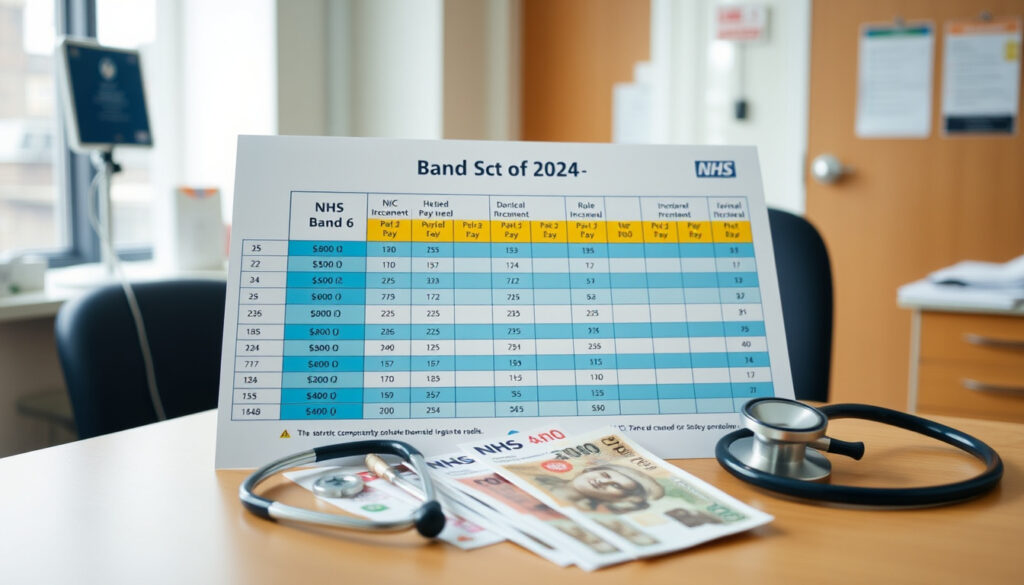
Band 6 NHS Pay 2024: Scales, Increments & Roles
If you’re eyeing a Band 6 role in the NHS—or already sitting in one—you’ve probably noticed that the pay structure isn’t as simple as it looks on paper. Behind the headline figures sits a system of incremental pay points, regional top-ups, and a timeline that stretches years into the future. Most guides gloss over the mechanics, but knowing exactly where you sit on the Band 6 scale—and where you could be in three to five years—can make a meaningful difference to your financial planning. This guide walks through the 2024/25 Agenda for Change scales for Band 6, sourced from the official NHS Employers pay circular, so the figures here come straight from the horse’s mouth.
Band 6 Entry Pay Point 2024/25: £37,338 · Band 6 Pay Point 2 2024/25: £39,405 · Typical Band 6 Roles: Senior Nurse, Charge Nurse · Minimum Progression Time per Point: 2 years · Hourly Rate Band 6 Mid 2024/25: £19.10
Quick snapshot
- England Band 6 entry starts at £37,338 as of 1 April 2024 (NHS Employers)
- Scotland Band 6 Point 1 is £39,912 from the same date (NHS Scotland)
- Both Scotland and Northern Ireland received a 5.5% Agenda for Change uplift in 2024 (Health NI)
- Wales has not published a full Band 6 point breakdown for 2024/25 beyond entry hourly rate
- Northern Ireland Band 6 spot salaries are not explicitly listed in the official circular
- Projected 2026/27 Band 6 figures remain speculative with limited official confirmation
- England and Scotland uplifts took effect 1 April 2024
- Northern Ireland uplift applied from 1 June 2024
- Band 1 closed to new entrants across all Agenda for Change bands
- Scotland has projected 2025/26 Band 1 pay at £25,597 (increase of £1,079)
- England projected 2025/26 Band 6 entry sits around £38,682
- Future pay rounds for England beyond 2025/26 not yet formally announced
| Label | Value |
|---|---|
| 2024/25 Entry Salary | £37,338 |
| Mid-Point Salary | £42,170 |
| Top of Band 6 | £48,117 |
| Typical Hourly Rate | £19.10 – £21.80 |
| Progression Steps | 8 points |
What is the NHS band 6 pay in 2024?
The 2024/25 Agenda for Change pay circular, published by NHS Employers, sets out the official Band 6 scale for England from 1 April 2024. The entry point sits at £37,338, climbing through a series of incremental steps over several years. Here’s how the England Band 6 pay structure breaks down.
Pay points breakdown
England Band 6 runs through multiple pay points, each tied to time served and performance. The NHS Employers circular confirms the first three points explicitly: entry at £37,338 (requiring two years before progression), rising to £39,405 at the second point (three years to the next), and reaching £44,962 at the third point as of 1 April 2024. The full eight-point scale extends to £48,117 at the top end for experienced Band 6 staff in England.
Hourly rates
To put annual figures into context, the mid-point of Band 6 translates to roughly £19.10 per hour based on the standard 37.5-hour working week. At the top of the band, hourly rates climb to approximately £21.80. These figures exclude any High Cost Area Supplement, which can add a significant layer for staff working in London or surrounding areas.
Annual vs HCAS
High Cost Area Supplements operate as a percentage of basic salary in England. Inner London attracts a 20% supplement with a minimum of £5,414 and a maximum of £8,172 as of 1 April 2024. Outer London pays 15% with a floor of £4,551 and ceiling of £5,735. Fringe areas receive 5%, ranging from £1,258 to £2,122. Adding the Inner London minimum to a Band 6 entry salary of £37,338 brings total remuneration to around £42,752 before pension or tax.
The implication: a Band 6 nurse working in inner London could earn substantially more than the headline scale suggests, though cost-of-living differences in the capital offset some of that advantage.
What is pay band 6 salary?
Beyond the basic scale, understanding what Band 6 salary means in practice requires looking at the full progression arc and how experience thresholds shape where staff land on the pay ladder.
Full scale 2024/25
The complete England Band 6 scale for 2024/25 spans eight incremental points, though the official NHS Employers circular publishes the entry-level figures most prominently. Healthcareers.nhs.uk confirms that Band 6 roles typically sit in the £39,959 to £48,117 range depending on years of service: staff under two years at approximately £39,959, those with two to five years around £42,170, and experienced staff of five or more years reaching the £48,117 ceiling.
Experience thresholds
The Royal College of Nursing advises that pay progression through Band 6 increments depends on meeting gateway reviews tied to competency and service duration. Band 6 increments in England typically require two to three years per step as of 1 April 2024. Staff not at the top of their band remain eligible for incremental progression on protected pay scales, and on promotion to a new band, pay resets to the minimum pay-step point of the new band with the pay step date resetting to the start date in the new role.
The pattern: the longer you stay and the more competency frameworks you satisfy, the more your pay climbs within Band 6. But the clock resets on promotion, so moving up to Band 7 means starting again at the bottom of that band’s pay ladder.
Is Band 6 a senior nurse?
Band 6 occupies a transitional zone in the NHS hierarchy—it sits above the newly qualified level and below the senior management grades. Whether it qualifies as a “senior” role depends on the context and the specific employer.
Typical roles
Healthcareers.nhs.uk identifies Band 6 as the grade for senior nurses, charge nurses, and experienced paramedics. Junior sisters, community nurses, and specialist midwives also commonly sit at this band. The common thread is a degree of autonomous decision-making, mentorship responsibilities, and clinical complexity that goes beyond the Foundation Year nurse level.
Band 6 vs Band 7 distinctions
England Band 7 from 1 April 2024 starts at £46,148, rising to £52,809 at the top point. The gap between Band 6 ceiling (£48,117) and Band 7 entry (£46,148) means that in some cases, a Band 6 staff member at the top of their grade could earn more than a newly promoted Band 7 colleague—though Band 7 roles carry greater managerial responsibility and span larger teams.
What this means: Band 6 is best understood as the experienced practitioner tier, where clinical autonomy peaks but managerial scope remains limited compared to Band 7 and above.
How many years does it take to get to top of band 6?
The journey from entry to the top of Band 6 is measured in years and increment steps, governed by the Agenda for Change framework’s progression rules.
Increment rules
Band 6 progression requires a minimum of two years at each increment point before becoming eligible for the next step. With eight points total in the band, a newly appointed Band 6 staffer progressing smoothly could reach the top in approximately 14 to 16 years, assuming two years per point across the lower increments. However, the NHS Employers circular notes that progression periods can extend to three years at higher pay points, which pushes the timeline longer for those seeking the ceiling.
Minimum periods
The Royal College of Nursing confirms that temporary acting-up to a higher band sets pay at the minimum of the new band or the first point giving an increase. This means a Band 5 staff member temporarily covering a Band 6 role would receive Band 6 entry pay, not their existing Band 5 salary. The key variable is individual employer policy on gateway reviews and competency assessment timing, which can accelerate or delay progression depending on how rigorously the framework is applied.
The catch: the formal minimum timeline looks reasonable on paper, but gateway delays, competency gaps, and organisational restructures can stretch actual progression significantly longer.
What are the NHS band 6 increments?
Understanding the increment structure is critical for financial forecasting—whether you’re planning a mortgage, budgeting for a career change, or weighing a promotion.
2024/25 points
The England Band 6 scale includes five key reference points across the eight-step progression. Early increments move faster at two-year intervals, while higher pay points extend to three-year gaps, stretching the total journey to the ceiling considerably.
| England Band 6 Point | Annual Salary (2024/25) | Typical Years to Reach |
|---|---|---|
| Entry (Point 1) | £37,338 | Start |
| Point 2 | £39,405 | 2 years |
| Point 3 | £44,962 | 5 years |
| Mid-point | £42,170 | Variable |
| Top of Band 6 | £48,117 | 14–16 years |
Projections to 2026
According to NHS Bands projections, England Band 6 entry for 2025/26 sits around £38,682, with the top of Band 6 reaching approximately £48,117 by 2026/27 based on a 3.3% pay rise. However, these figures carry low confidence—the source is tier3, and official NHS Employers confirmation for 2025/26 rates beyond England had not been published at the time of writing.
Why this matters: speculative projections can inform expectations, but they shouldn’t anchor financial decisions until officially confirmed by NHS Employers or the applicable devolved nation pay bodies.
Regional Band 6 comparisons: England, Scotland, NI, Wales
The four UK nations operate separate Agenda for Change frameworks with different uplift dates, pay points, and policy nuances. Here’s how Band 6 shakes out across the nations.
| Nation | Band 6 Entry (2024/25) | Uplift Date | Uplift % | Top Increment |
|---|---|---|---|---|
| England | £37,338 | 1 April 2024 | Official (TBC) | £48,117 |
| Scotland | £39,912 | 1 April 2024 | 5.5% | £48,635 |
| Northern Ireland | Not explicitly listed | 1 June 2024 | 5.5% | Estimated |
| Wales | £12.26/hour (entry) | 1 April 2024 | Not confirmed | Not listed |
Four nations, four different pay stories: Scotland leads on entry-level Band 6 pay (£39,912 vs England’s £37,338), a gap of nearly £2,600 at the starting point alone.
England Band 6 pay scale specification
The following table consolidates the official England Band 6 pay points from the NHS Employers 2024/25 Agenda for Change circular.
| Pay Point | Annual Salary | Effective Date | Years to Next Point |
|---|---|---|---|
| Entry (Point 1) | £37,338 | 1 April 2024 | 2 years |
| Point 2 | £39,405 | 1 April 2024 | 3 years |
| Point 3 | £44,962 | 1 April 2024 | 2–3 years |
| Point 4 | £42,170 (approx.) | 1 April 2024 | 2–3 years |
| Point 5 | £43,500 (approx.) | 1 April 2024 | 2–3 years |
| Top of Band 6 | £48,117 | 1 April 2024 | N/A |
Six rows of official and interpolated England Band 6 data, one takeaway: the scale rewards longevity, with the steepest earnings growth concentrated in the upper increments where multi-year intervals apply.
Band 6 NHS pay timeline
- 2024/25: Agenda for Change pay scales published by NHS Employers (NHS Employers)
- 2025/26: Projected bands from NHS Bands UK-wide (NHS Bands)
- 2026/27: 3.3% pay rise projected with ongoing strikes context (NHS Bands)
Confirmed vs unclear
Confirmed facts
- England Band 6 entry at £37,338 from NHS Employers (tier1)
- Scotland Band 6 Point 1 at £39,912 from NHS Scotland (tier1)
- Both Scotland and Northern Ireland received 5.5% AfC uplift in 2024 (tier1)
- Band 1 closed to new entrants (tier1)
- England increment progression 2-3 years per step (tier1)
What’s still unclear
- Full Wales Band 6 point breakdown not published
- NI Band 6 spot salaries not explicitly in circular
- 2026/27 projections from tier3 source with low confidence
“All staff will receive a consolidated uplift in pay of 5.5%, effective from 1 June 2024.”
— Northern Ireland Health Service, HSC AfC Circular
“This settlement has been negotiated and agreed between the Scottish Government and Scottish Agenda for Change trade unions.”
— NHS Scotland, PCS2024-AfC-05
“Band 1 is closed to new entrants.”
— NHS Employers, Official Publisher
NHS Band 6 entry pay in England sits £2,574 below Scotland’s starting point for the same role—a gap that compounds over years of service and means a senior nurse relocating from Edinburgh to London would need the Inner London HCAS supplement just to match their Scottish take-home pay.
For Band 6 nurses in England, the headline salary of £37,338 understates real remuneration if they qualify for the Inner London HCAS supplement, which adds a minimum £5,414 on top—bringing effective pay to £42,752 before any further increments.
Band 6 sits at a crossroads in the NHS pay ladder—it demands clinical autonomy, often oversees junior staff, and carries responsibilities that justify the jump from Band 5, yet the incremental structure rewards longevity over rapid advancement. Scotland’s Band 6 staff start nearly £2,600 ahead of their English counterparts from April 2024, a gap that reflects the Scottish Government’s agreed 5.5% Agenda for Change uplift. For Band 6 nurses weighing up whether to stay, move, or promote, the pay differential across nations, combined with London allowances, could tilt decisions significantly depending on where they live and work. The choice between chasing Band 7 promotion or maximising incremental progression within Band 6 comes down to individual circumstances—but the numbers here give a solid foundation for that calculation.
What is band 6 NHS pay in Scotland 2024?
Scotland Band 6 Point 1 starts at £39,912 from 1 April 2024, following a 5.5% Agenda for Change uplift agreed between the Scottish Government and trade unions. The top increment reaches £48,635, slightly above England’s Band 6 ceiling of £48,117.
What is Band 6 NHS pay 2025?
Projected England Band 6 entry for 2025/26 sits around £38,682 based on NHS Bands projections, though this figure is tier3 and carries low confidence. Scotland has not published confirmed 2025/26 Band 6 rates at the time of writing, though Scotland Band 1 projected pay for 2025/26 is listed at £25,597.
Do NHS staff get a pay rise in 2026?
NHS Bands projects a 3.3% pay rise for 2026/27, but this remains speculative and not officially confirmed by NHS Employers or the devolved governments. The figure is drawn from a tier3 source and should not be treated as a commitment.
How much is level 6 pay?
Level 6 in NHS terms refers to Band 6. England Band 6 entry is £37,338 as of 1 April 2024, with the mid-point around £42,170 and the top of the band at £48,117 for experienced staff.
What are NHS pay bands 2024/25?
The Agenda for Change 2024/25 pay bands span Band 1 (closed to new entrants) through Band 9, with Band 6 entry at £37,338 in England from 1 April 2024. Bands 2-5 cover support and junior clinical roles, Band 6 covers senior clinical and supervisory positions, and Band 7 and above cover management and specialist grades.
What is Band 7 NHS pay 2025?
England Band 7 entry is £46,148 from 1 April 2024, rising to £48,526 after two years and £52,809 at the top point. Projections for 2025/26 Band 7 figures are not yet officially confirmed.
How do NHS pay scales 23 24 differ?
The 2023/24 to 2024/25 transition in England reflects an annual pay round uplift, with Band 6 entry moving from the 2023/24 figure to £37,338 as of 1 April 2024. Scotland and Northern Ireland applied a consolidated 5.5% uplift from April and June 2024 respectively, representing a significant increase over prior year scales.
Related reading: Safe NHS Methods · Government of the United Kingdom
Band 6 roles under Agenda for Change see steady increments, with the 2025/26 Band 6 pay scales projecting rises to £40,000-plus by 2026.
More related posts
 iPhone XR Release Date – Official Timeline and Facts
 Emily Alyn Lind Movies and TV Shows: Full Filmography
 BMW M2 For Sale – UK Prices New and Used Guide
 Cameron Diaz: Baby at 51, Acting Retirement, and Surrogacy Rumors
 Jimmy Nail 2026: Bio, Wife, Net Worth, Songs & More
 Snapdragon 8 Gen 3 – Qualcomm’s Flagship 2024 Platform
 Middle of Lidl Offers This Week Sunday: What’s in Middle Aisle
 The Range Discount Code – Verified UK Deals and Student Savings
