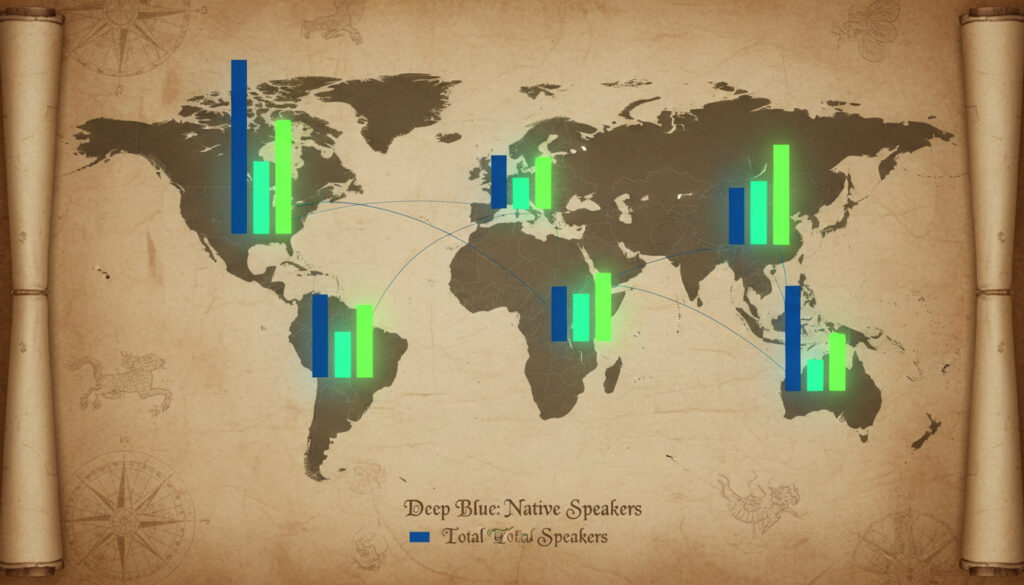
Most Spoken Language in the World – Native vs Total Speakers 2024
The question of which language dominates global communication yields two distinct answers depending on how one counts. When measured by native speakers, Mandarin Chinese stands unchallenged with nearly one billion first-language users. Yet when including second-language proficiency, English surges ahead with approximately 1.5 billion total speakers, representing nearly 19 percent of the world’s population.
These figures reflect more than demographic scale. They indicate divergent patterns of linguistic influence: Mandarin’s concentration within China’s borders versus English’s diffusion across global education, commerce, and digital networks. The distinction between native and non-native speaker counts reveals fundamentally different modes of language spread—one through population growth, the other through institutional adoption.
Current rankings draw from aggregated 2024 data published by Ethnologue, Wikipedia’s collaborative linguistic monitoring, and academic demographic tracking. This analysis examines the top ten languages by both metrics, explores the methodological challenges of counting speakers, and addresses why Mandarin and English exchange positions depending on the criteria applied.
What is the most spoken language in the world?
Mandarin Chinese (~988 million)
English (~1.5 billion)
Ethnologue 2024
Native vs. L2 Acquisition
- Mandarin Chinese maintains the largest first-language population globally, with estimates ranging between 885 and 988 million native speakers.
- English reaches approximately 1.493 billion total speakers, though only 372 million (25%) speak it as their first language.
- Hindi ranks third in total speakers at 611 million, surpassing Spanish when combining L1 and L2 populations.
- Modern Standard Arabic presents a unique case with zero native speakers but 335 million second-language users.
- Statistical variations of 10-15% exist between sources due to differing definitions of fluency and dialect inclusion criteria.
- The global language inventory exceeds 7,170 living languages, though the top ten account for the majority of human communication.
- Only three languages—English, Mandarin, and Hindi—exceed 600 million total speakers.
| Language | Native (L1) | Total (L1+L2) | % World Population |
|---|---|---|---|
| English | 372 million | 1,493 million | 18.8% |
| Mandarin Chinese | 988 million | 1,183 million | 13.8% |
| Hindi | 347 million | 611 million | 7.5% |
| Spanish | 487 million | 561 million | 6.9% |
| Modern Standard Arabic | 0 | 335 million | 3.4% |
| French | 75 million | 334 million | 3.4% |
| Bengali | 234 million | 274 million | 3.4% |
| Portuguese | 252 million | 269 million | 3.2% |
| Russian | 133 million | 210 million | 3.2% |
| Urdu | 78 million | 246 million | 2.9% |
What are the top 10 most spoken languages worldwide?
How many people speak Mandarin Chinese?
Mandarin Chinese encompasses approximately 988 million native speakers concentrated primarily within the People’s Republic of China. Including second-language learners, the total reaches 1.183 billion, representing 13.8 percent of the global population. The language’s demographic weight stems from China’s population density rather than colonial spread or international adoption.
How many speakers does English have worldwide?
English demonstrates unprecedented reach through second-language acquisition, with 1.121 billion L2 speakers supplementing 372 million native speakers. This asymmetry—where only 25% of users speak it from childhood—distinguishes English from other major languages. The 1.493 billion total includes varying proficiency levels, from basic comprehension to professional fluency.
Which language has the most native speakers?
Mandarin Chinese maintains the definitive lead in native speaker populations, followed by Spanish at 487 million and English at 372 million. This ranking reflects distinct historical patterns: Mandarin’s dominance through continuous demographic concentration in East Asia, Spanish through colonial expansion across the Americas, and English through historical migration and institutional spread.
Wikipedia aggregates 2022–2024 data excluding creoles, while Harper College draws from older Ethnologue editions. The 1.5 billion figure for English includes varying L2 proficiency levels, from basic communication to professional fluency.
Is English or Mandarin more widely spoken?
Does Mandarin have more speakers than English?
Mandarin exceeds English only when counting native speakers exclusively. By total speakers including L2 populations, English surpasses Mandarin by approximately 300 million people. This inversion occurs because Mandarin functions primarily as a first language within China, with limited adoption as a second language internationally compared to English’s global educational footprint.
Why does English dominate as a second language?
English serves as the primary medium for international aviation, scientific publishing, and digital content. Unlike Mandarin, which spread through population growth within a continuous geographic territory, English expanded through centuries of colonial administration followed by 20th-century American economic and cultural influence. This institutional embedding creates compulsory English education in most national systems.
Which language offers broader geographic coverage?
English maintains official or recognized status in over 60 sovereign states across every continent. Mandarin, while spoken by enormous populations, concentrates heavily within China, Taiwan, and Singapore. Understanding these geographic patterns parallels studying historical exploration routes like the Cape of Good Hope, where maritime passages facilitated linguistic exchange and cultural diffusion across previously disconnected regions.
What is the difference between native and total speakers?
Linguists classify speakers into two primary categories. L1 or native speakers acquire language from birth through natural immersion in family environments. L2 or second-language speakers acquire proficiency through formal education, immigration, or professional necessity after early childhood. This distinction proves crucial because L1 populations indicate organic cultural continuity, while L2 populations reveal institutional and economic influence.
The gap between these metrics varies dramatically by language. Mandarin shows a relatively small L2 population of 194 million compared to its 988 million native speakers. Conversely, English demonstrates an L2 population three times larger than its native base. Modern Standard Arabic represents an extreme case: zero native speakers yet 335 million L2 users, functioning exclusively as a liturgical and formal diplomatic language.
Ethnologue defines L1 speakers as those acquiring language from birth in home environments. L2 counts typically require functional capacity for professional or educational communication, though specific thresholds vary by research institution.
Conflicts between English totals (1.493B vs 1.5B) stem from inconsistent L2 counting methods. Some sources include basic English knowledge, while others require active usage capability.
How have global language rankings shifted over recent decades?
- : English establishes dominance in international aviation and emerging scientific publishing standards.
- : Spanish solidifies position across Latin America while Mandarin recognizes demographic concentration within China’s borders.
- : Mandarin Chinese achieves undisputed status as the language with the largest L1 population globally.
- : Digital communication infrastructure accelerates English L2 acquisition in South Asia and Sub-Saharan Africa.
- : Hindi surpasses Spanish in combined L1+L2 rankings due to population growth and educational spread.
- : Current data stabilizes with English at 1.493 billion and Mandarin at 1.183 billion total speakers.
How reliable are language speaker counts?
| Established Information | Uncertain or Variable |
|---|---|
| Ethnologue provides authoritative L1 population data for major languages | Exact L2 proficiency thresholds vary significantly between academic sources |
| National census data from China, India, and the US provide robust native speaker counts | Dialect versus language distinctions (e.g., Chinese varieties) create classification disputes |
| The top three languages by native speakers remain consistent: Mandarin, Spanish, English | Undocumented speakers in remote regions and conflict zones remain uncounted |
| Forbes India confirms 2024 Ethnologue rankings for major languages | Self-reported fluency in surveys often overestimates actual language capability |
Why does the native versus total speakers distinction matter?
The divergence between L1 and L2 populations indicates fundamentally different forms of linguistic power. Languages with large native bases, such as Mandarin, represent concentrated demographic weight and cultural continuity within specific geographic regions. Conversely, languages with substantial L2 populations, particularly English, demonstrate institutional spread—their utility residing in international systems rather than ethnic identity.
This distinction shapes global education markets, translation industries, and diplomatic protocols. A language with 300 million L2 speakers, like Arabic, functions differently in international relations than a language with 300 million L1 speakers, like Spanish. The former operates primarily through formal education and religious instruction; the latter through media, migration, and regional commerce. Comprehending these mechanisms requires analytical precision similar to examining What Does Empathy Mean in cross-cultural communication contexts.
Where do linguists source global speaker data?
Mandarin Chinese (incl. Standard Chinese): 988 million L1, 194 million L2, 1,183 million total (13.8%).
The world has approximately 7,170 languages currently in use, with the top 200 accounting for the vast majority of human communication.
— Ethnologue Language Documentation
What is the most spoken language in 2024?
As of 2024, Mandarin Chinese maintains the largest population of native speakers at approximately 988 million, while English leads in total speakers with 1.493 billion including second-language users. Hindi ranks third overall at 611 million, followed by Spanish at 561 million. These rankings remain stable across major linguistic databases, though the gap between English and Mandarin continues to widen in total speaker counts due to accelerating L2 acquisition in South Asia and Africa.
Frequently Asked Questions
Why is Mandarin considered the most spoken language?
Mandarin holds the title for most native speakers due to China’s population size, with 885–988 million first-language users. However, this does not include second-language speakers, where English dominates. The classification depends entirely on whether measuring L1 populations or total global proficiency.
How many languages exist worldwide?
Ethnologue documents approximately 7,170 living languages worldwide currently. This figure represents continuous documentation efforts, with some languages disappearing annually while others achieve recognition. The count includes established national languages and regional dialects meeting specific structural criteria.
What percentage of English speakers are non-native?
Approximately 74–75% of English speakers worldwide acquire it as a second language rather than from birth. Of the 1.5 billion total English speakers, only 372 million speak it natively, making non-native speakers the overwhelming majority.
Is Spanish more widely spoken than Hindi?
By total speakers, Hindi surpasses Spanish with 611 million versus 561 million combined L1 and L2 populations. However, Spanish maintains higher native speaker numbers at 487 million compared to Hindi’s 347 million first-language users.
Which language is growing fastest by total speakers?
English demonstrates the fastest growth in total speakers, primarily through L2 acquisition in education systems across South Asia and Africa. Mandarin remains stable in native growth but shows limited L2 expansion beyond Chinese borders.
More related posts
 Kim Seok-jin – Age, Military Service and Solo Career
 Metals One Plc Share Price – Live Charts and Analysis
 Folding Table and Chairs – Best Sets for 2 to 6 Seats
 How to Remove Skin Tags – Safest Professional Methods
 iPhone Pro Max 16 – UK Prices, Deals and Specs
 Polly Walker Movies and TV Shows – Full Filmography from Rome to Bridgerton
 Mlp Fluttershy: Complete Guide to the Shy Pegasus
 What Will Digital ID Be Used For – Key Uses in Services
