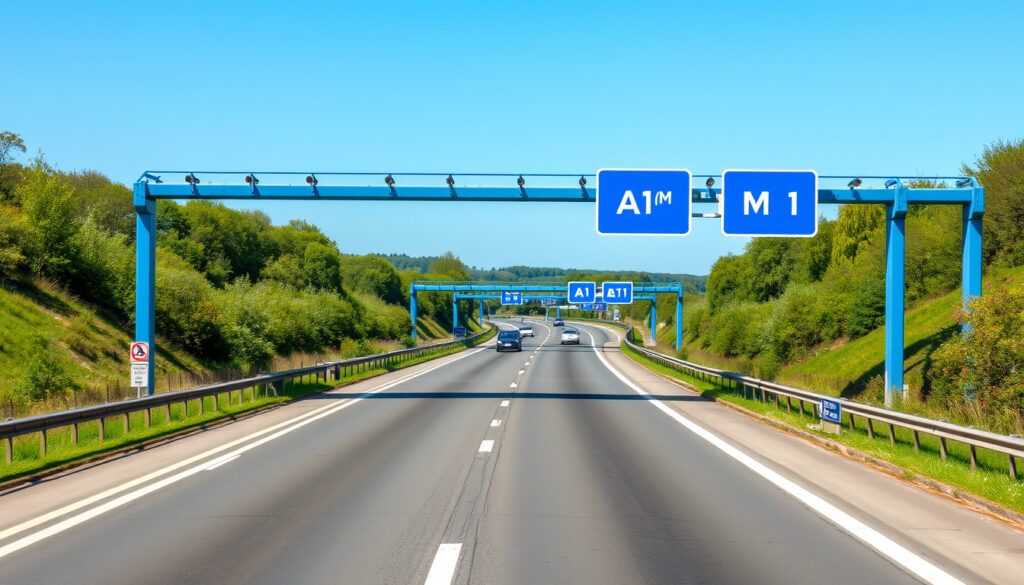
A1(M) Motorway Explained: Meaning and Differences from A1 & M1
The A1(M) is a quirky designation on UK road signs—a hybrid that marks four separate motorway sections stitched together along the historic A1 trunk route, catching many drivers off guard because no two A1(M) stretches actually connect to each other without a gap of ordinary A-road in between.
Number of sections: 4 · Upgraded from: A1 road · UK’s longest numbered road: A1 · Designation type: Motorway sections · Primary route: North-south trunk road
Quick snapshot
- Four motorway sections carry the A1(M) designation Wikipedia (A1(M) motorway encyclopedia entry)
- Not the UK’s longest motorway — that title belongs to the M6 Wikipedia (A1(M) motorway encyclopedia entry)
- Exact lengths of each A1(M) section vary across sources
- Current closure and traffic conditions require live monitoring
- Doncaster Bypass opened 1961 — Britain’s oldest motorway stretch Wikipedia (A1(M) motorway encyclopedia entry)
- Leeming-Barton link completed 29 March 2018, merging two previous fragments Wikipedia (A1(M) motorway encyclopedia entry)
- No current confirmed dualling plans north of Newcastle (Wikipedia (A1(M) motorway encyclopedia entry))
- Scotland section remains trunk road only — no motorway upgrade scheduled Wikipedia (A1(M) motorway encyclopedia entry)
The table below summarizes the key distinguishing features between non-motorway A1 sections and A1(M) motorway sections.
| Label | Value |
|---|---|
| Total Sections | 4 |
| Original Road | A1 trunk road |
| Status | Motorway designation |
| Main Path | England north-south |
Why is it called the A1(M)?
The notation tells a story. Britain’s road-numbering system dates back to the 1920s, when the Ministry of Transport assigned numbers to the most important routes connecting major cities. The A1 earned the honour of being the first number — designated the primary London-to-Edinburgh route, running approximately 380 miles through Hatfield, Stevenage, Doncaster, and Newcastle-upon-Tyne Roads.org.uk (UK road infrastructure reference). When sections of this historic trunk road were upgraded to motorway standard, they couldn’t simply become M1 or any other M-prefix — that would cause confusion with existing motorway numbers. The solution was to keep the A1 identity while adding the (M) suffix to mark motorway-grade segments Wikipedia (A1(M) motorway encyclopedia entry).
Historical numbering system
The UK’s A-road numbering convention assigns single digits to the most critical national arteries. A1 sits at the top because it links the two largest cities in Britain. When motorway construction began in the late 1950s, planners faced a naming puzzle: how to designate upgraded A-roads that had become motorways without abandoning their original identity or stepping on established motorway names Wikipedia (A1 road Great Britain entry).
- A-roads predate motorways in the numbering system
- (M) suffix preserves original route identity while marking motorway standard
- Hybrid designations signal that motorway rules apply only in those sections
Upgrade from A1 road
Not every stretch of the A1 became a motorway. Instead, specific sections were rebuilt to full motorway specification — meaning controlled access, grade-separated junctions, and no pedestrians, cyclists, or slow-moving farm vehicles. The Doncaster Bypass holds the distinction of being the first A1(M) section, opening in 1961 Wikipedia (A1(M) motorway encyclopedia entry). Subsequent upgrades added more segments, but the trunk road character of the A1 remained between these upgraded pieces.
Roads.org.uk planning documents reveal that Hatfield-area A1(M) sections were originally drawn with twin viaducts — a more ambitious design that was later revised to a tunnel-and-roundabout layout due to costs, showing how practical constraints shape these hybrid designations.
What does A1(M) mean?
Breaking down the notation: the letter “A” marks a primary route, while “(M)” indicates motorway standard for that specific stretch. The A1(M) therefore reads as “primary route A1, motorway sections only” — a clear signal that non-motorway stretches still exist along the same corridor. This matters legally too, because motorway restrictions apply strictly within A1(M) sections, while the non-M portions of A1 operate under different rules Narkive UK Travel Forum (driver discussion on road rules).
Breakdown of the notation
- A = Primary or “trunk” road classification
- (M) = Suffix indicating motorway-standard upgraded section
- Combined: A1(M) = Motorway-grade segments along the A1 corridor
Comparison to full motorways like M1
Unlike continuous motorways such as the M1, which runs unbroken from London to Leeds as a motorway throughout, the A1(M) exists only in fragments. The M1 connects London to Leeds across approximately 193 miles of uninterrupted motorway, joining the A1(M) near Aberford to continue toward Newcastle Wikipedia (M1 motorway encyclopedia entry). The A1(M), by contrast, consists of four separate sections with gaps of ordinary A-road between them — a fundamental structural difference.
Stirling Corner on the A1(M) sits 40-50 metres higher than the adjacent M1 in the valley below, linked by Scratchwood Link — a topographic quirk that reminds drivers these routes serve the same corridor while following entirely different terrain Roads.org.uk (A1 and A1(M) route analysis).
The M1 offers consistent motorway speeds throughout, while the A1(M) provides faster passage through some segments but requires transition through non-motorway A1 stretches — a routing decision that depends entirely on destination and time of day.
What is the difference between A1 and A1(M)?
The distinction comes down to road standards and legal restrictions. The A1 as a trunk road includes both dual-carriageway sections and single-carriageway stretches, particularly north of Newcastle toward Edinburgh where alternating carriageways persist. Speed limits on non-motorway A1 sections commonly sit at 50-60 mph, with fewer speed cameras and lighter traffic than the M1 in some stretches Honest John Forum (driver experience comparison). The A1(M), by contrast, enforces full motorway regulations — no pedestrians, no pedal cycles, no learner drivers, no vehicles prohibited from motorways.
Road standards
Motorway-standard roads feature controlled access points, meaning vehicles can only enter and exit at designated junctions rather than from side roads or private driveways. The A1(M) sections meet this criterion, while non-M A1 segments may have at-grade junctions, direct driveway access, and roundabouts — characteristics incompatible with high-speed motorway traffic.
The comparison below highlights how motorway-grade A1(M) sections differ operationally from standard A1 trunk-road segments.
| Feature | A1 (non-M sections) | A1(M) motorway sections |
|---|---|---|
| Speed limits | 50-60 mph typical | 70 mph standard |
| Access control | Partial — some at-grade junctions | Full — grade-separated only |
| Pedestrians/cyclists | Permitted on verges | Prohibited |
| Learner drivers | Permitted | Prohibited |
| Breakdown lanes | Varies | Mandatory hard shoulder |
What this means for drivers is that A1(M) sections demand full motorway discipline, while A1 non-M stretches operate under more flexible trunk-road rules.
Route continuity
One key practical difference: the A1 route stretches approximately 380 miles from London to Edinburgh, while the M1 covers roughly 193 miles to Leeds. For certain commutes, the A1 at 180 miles offers a shorter route than the M1’s 193 miles, but non-M sections impose slower speeds and occasional single-carriageway bottlenecks YouTube — Auto Shenanigans (practical route comparison). Drivers choosing between routes must account for this trade-off between distance and consistent speed.
Non-motorway A1 sections north of Newcastle alternate between dual and single carriageways, meaning journey times become less predictable compared to the M1’s steady motorway speeds — a factor truck operators and time-sensitive travellers weigh heavily.
Are the A1 and M1 the same?
No — they are distinct roads despite serving parallel corridors. The M1 is Britain’s first full inter-urban motorway, designed by Owen Williams and Hertfordshire County Council, built by John Laing and Tarmac, and opened in 1959 Institution of Civil Engineers (official history of UK motorways). The M1 follows a more westerly alignment through the Midlands, while the A1 takes a more easterly route, passing closer to the coast. The two routes run within visual distance of each other in Yorkshire, where the M1’s reconstruction north of the M62 between 1996 and 1999 extended it to join the A1(M) at Aberford Wikipedia (M1 motorway encyclopedia entry).
Separate routes
The M1 and A1 diverge immediately south of London, with the M1 heading northwest through Luton and Northampton while the A1 bears east through Hertfordshire. They converge only in the Leeds area, where the M1 terminates at Aberford and traffic continues toward Newcastle via the A1(M). This separation means they serve different catchment areas entirely.
Overlaps and parallels
The only point where M1 and A1(M) physically connect is near Aberford, where the M1 ends and the A1(M) begins. This junction represents a critical interchange for northbound traffic: drivers from London can either continue on the M1 to Leeds or transfer to the A1(M) for a more direct eastern route toward Newcastle.
The implication for north-south travellers is that route choice between M1 and A1(M) hinges on whether consistency of motorway conditions outweighs the potential distance saving via A1.
For logistics operators planning recurring north-south runs, the M1’s unbroken motorway status typically wins on reliability, while the A1(M) corridor rewards those who know exactly where the motorway sections begin and end.
Is the A1(M) a motorway?
Yes, but only in those specific sections. The A1(M) stretches meet full motorway construction and regulatory standards, meaning controlled access, no slow vehicles, and 70 mph limits. However, the designation intentionally stops short of claiming the entire A1 corridor as a motorway — because between those upgraded sections, the road remains a trunk road with all its associated characteristics Roads.org.uk (A1 and A1(M) route data). The four A1(M) sections are discontinuous, and drivers must transition through non-motorway stretches to travel from one to another.
Motorway features
- Full controlled access — no direct property access or at-grade junctions
- Mandatory hard shoulders for breakdowns
- 70 mph national speed limit (lower where variable limits apply)
- No pedestrians, cyclists, agricultural vehicles, or learner drivers
Limitations vs full motorways
The critical limitation is discontinuity. Unlike a true motorway such as the M1 or M6, the A1(M) requires drivers to exit motorway restrictions at section boundaries and re-enter them later. This affects journey planning, as traffic management strategies and speed limits differ between M-rated and non-M segments of the same corridor.
What checks out
- A1(M) = four motorway sections on the A1 route
- Not the UK’s longest motorway — the M6 holds that record
- The Doncaster Bypass opened 1961 as the first A1(M) segment
- M1 terminates at Leeds and connects to A1(M) at Aberford
What remains fuzzy
- Official government Highways England documentation on current classifications has limited public availability
- Exact total length of A1(M) combined varies across sources
- Real-time traffic and closure data require live monitoring tools
The A1(M) designation applies to a series of four separate motorway sections in the UK, representing upgrades of the historic A1 trunk road running from London to Edinburgh.
— Wikipedia (A1(M) motorway encyclopedia entry)
The M1 motorway connects London to Leeds, where it joins the A1(M) near Aberford to continue the route toward Newcastle.
— Institution of Civil Engineers (official history of UK motorways)
The A1(M) story reflects a practical compromise in British road planning: honouring an historic route number while progressively upgrading key sections to motorway standard. Unlike the Preston Bypass (now M6), which opened on 5 December 1958 as Britain’s very first motorway section Wrightstart (Great British motorway history), the A1(M) segments were added piecemeal over decades — with the Leeming-Barton link completing on 29 March 2018 finally merging two previously separate fragments Wikipedia (A1(M) motorway encyclopedia entry).
For drivers navigating north-south England, the choice between M1 and A1(M) corridors involves real trade-offs. The M1 offers certainty — a continuous motorway with consistent speeds and facilities. The A1(M) can shave distance off certain routes but demands tolerance for transition between motorway and trunk-road conditions. Neither route touches Scotland with motorway status: the A1 from Newcastle to Edinburgh remains a trunk road with alternating carriageways, meaning the A1(M) designation stops at the English-Scottish border Wikipedia (A1 road Great Britain entry).
For long-haul drivers and logistics operators weighing these routes, the calculation is straightforward: head toward Leeds and the M1 for reliable motorway coverage through the Midlands, or bear east toward the A1(M) corridor for a potentially shorter but less predictable journey where motorway stretches punctuate trunk-road segments. Understanding the hybrid designation isn’t academic — it directly shapes route choice, journey time estimates, and fuel planning.
Related reading: UK Driving Theory Test · Government of the United Kingdom
On the A1(M), reflective studs’ colours and meanings provide essential guidance for drivers, much like those dividing lanes on the parallel M1.
Frequently asked questions
Is the A1 the longest motorway in the UK?
No. The A1 is a trunk road, not a motorway. The UK’s longest motorway is the M6. The A1 road runs approximately 380 miles from London to Edinburgh, but only four sections carry the A1(M) motorway designation.
What is the hardest motorway to drive on?
Difficulty ratings vary by driver experience and conditions. The M1 sees heavy congestion around London and Birmingham. The A1(M) sections can be challenging due to older design standards on the Doncaster Bypass (1961). However, no official government ranking designates a “hardest” motorway.
What is the deadliest motorway in the UK?
Safety statistics change year by year. The M1 and M6, as the longest and most heavily trafficked motorways, tend to record higher absolute accident numbers. Per-mile rates tell a different story and require current Department for Transport data to answer accurately.
What are A1(M) road conditions like?
Road conditions on A1(M) sections are generally good, as motorway-standard maintenance applies. However, conditions vary by section and season. Live traffic updates from National Highways or traffic monitoring services provide current status for any planned works or incidents.
Where can I find A1(M) traffic news?
National Highways provides live traffic information for motorways in England, including A1(M) sections. Traffic monitoring apps and the BBC Travel News service also offer real-time updates on closures, accidents, and congestion affecting the route.
What junctions are on the A1(M)?
The A1(M) includes junctions at key points including those serving Doncaster, Leeds (via M1 connection at Aberford), and sections toward Newcastle. Exact junction numbering follows the A1 sequence rather than starting fresh.
Is there an A1(M) route map available?
Official maps from National Highways and third-party services like Google Maps and RouteOne show the A1(M) sections. These maps clearly mark where the A1(M) motorway segments begin and end along the broader A1 corridor.
More related posts
 Walter White: The Complete Guide to Breaking Bad’s Heisenberg
 Secret Santa Gift Ideas: Best Affordable Picks 2024
 How to Make Coffee – Essential Ratios and Brewing Methods
 Allan Saint-Maximin: Career, Stats, and Controversial Departures
 Ma Dong-seok: Biography, Net Worth, Movies, Wife, and Languages
 Where Is the Liver Located? Anatomy, Pain & Functions
 Is Palestine a Country? Status, Recognition, and History
 Shower Tray and Screen – Sizes and Deals at Screwfix B&Q
