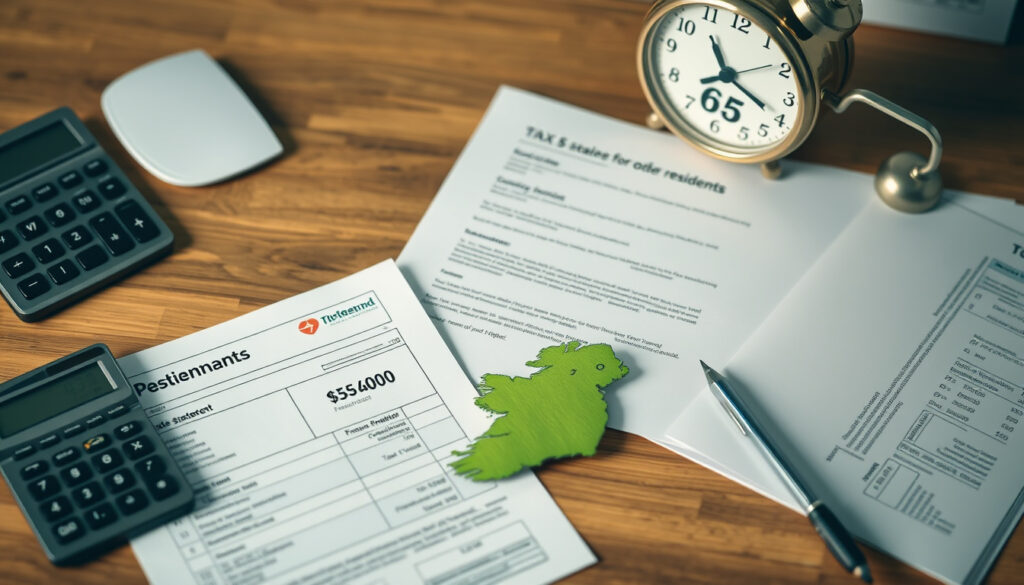
HMRC Over 65 Tax Changes: Allowances, Pension & Ireland Rules
If you’re over 65 in the UK, the tax landscape has shifted quietly but sharply. The personal allowance has been frozen at £12,570 for 2025-26, and more of your savings interest is being pulled into the tax net — this guide cuts through the noise to show you exactly how much you can earn before tax, how gifting to a spouse works, and what happens to your UK state pension if you move to Ireland.
Over-65s paying more income tax on savings interest: 21.5% increase forecast (2026) ·
Standard Personal Allowance for 2025-26: £12,570 ·
Age-related allowance (over 65 with income under threshold): Up to £12,570 (frozen) ·
State Pension full new amount (2025-26): £221.20 per week ·
Minimum number of qualifying years for full State Pension: 35
Quick snapshot
- Personal Allowance 2025-26: £12,570 (HM Government / GOV.UK)
- State Pension is taxable income (Age UK)
- Spousal gifts exempt from Inheritance Tax (HM Government / GOV.UK)
- Whether Labour will increase personal tax allowance in next budget
- Exact future of age-related allowance after 2026
- Impact of potential changes to marriage allowance
- April 2025: Personal allowance frozen at £12,570 (Association of Taxation Technicians)
- April 2026: Forecast 21.5% rise in tax on over-65s savings interest (Moneyfacts)
- 2026-27: Personal allowance still £12,570 (Deloitte TaxScape)
- Triple lock may increase State Pension further (Deloitte TaxScape)
Six key numbers define the tax situation for over-65s in 2025-26, and they reveal a pattern of frozen thresholds that quietly push more pension income into the taxable band.
| Allowance / limit | Value 2025-26 |
|---|---|
| Standard Personal Allowance | £12,570 |
| Personal Savings Allowance (basic rate) | £1,000 |
| New State Pension weekly amount | £221.20 |
| Minimum qualifying years for full State Pension | 35 |
| Marriage Allowance transfer value | £1,260 per year |
| Annual gift exemption (Inheritance Tax) | £3,000 |
How much can a pensioner earn before paying tax UK?
The answer is not a single number — it depends on the mix of pension income, savings interest, and other earnings. Here’s how the main allowances work.
Personal allowance for pensioners 2025-26
The standard Personal Allowance is £12,570 for everyone under 65 — and for those over 65, there is no separate age-related allowance anymore. As confirmed by the UK Government’s latest rates table, everyone gets the same personal allowance regardless of age (HM Government / GOV.UK). The allowance is frozen until April 2028. If your income exceeds £100,000, the allowance shrinks by £1 for every £2 of additional income.
Age-related allowance vs standard allowance
The old age-related Personal Allowance (which was higher for those aged 65–74 and 75+) was effectively abolished in 2015. For 2025-26, all pensioners use the standard £12,570. Deloitte’s 2026-27 tax table confirms that “the standard age-related personal allowances are not part of the current UK system” (Deloitte TaxScape).
Income that counts towards your allowance
- State Pension (new or basic) — fully taxable
- Workplace pension income
- Employment earnings (if you still work)
- Rental income
- Savings interest above the Personal Savings Allowance
The implication: because the State Pension itself already uses up a large chunk of the allowance — £11,502 for the full new State Pension — any additional income (like a small private pension or savings interest) can quickly trigger a tax bill.
Can I gift money to my wife?
One of the most common questions among older couples is how much they can give without triggering tax. The short answer: spousal gifts are treated very generously by HMRC.
Gift tax rules between spouses
UK Inheritance Tax rules exempt transfers between married couples and civil partners. There is no limit on the amount you can give to your spouse without incurring tax (HM Government / GOV.UK). This applies during your lifetime and on death.
Annual gift allowance limits
For gifts to other individuals (e.g., children or grandchildren), the annual exemption is £3,000 per donor. This amount resets each tax year and can be carried forward one year if unused.
A married couple can give each other unlimited sums tax-free — but gifts to children over £3,000 a year start counting toward the nil-rate band of £325,000.
Gifts that may still be subject to Inheritance Tax
- Gifts to non-spouses above the annual exemption
- Gifts made within 7 years of death (taper relief applies)
- Transfers into a trust above the nil-rate band
The catch: while spousal gifts are free of Inheritance Tax, the recipient spouse’s estate may later face tax on the same assets if they exceed the threshold.
What happens to my UK state pension if I move to Ireland?
Moving to Ireland after retirement is a popular option, and the UK State Pension follows you — but the tax treatment changes.
UK State Pension payments abroad
The UK State Pension can be paid to any country in the world. There is no automatic reduction or freeze when moving to Ireland, unlike some other countries. You continue to receive the full amount, including annual increases under the triple lock (HM Government / GOV.UK).
Tax implications of living in Ireland with UK pension
The UK-Ireland Double Taxation Agreement prevents you from being taxed twice. Under the treaty, your UK State Pension is taxable only in Ireland, not the UK. This means you report the pension income on your Irish tax return and may owe Irish income tax on it. Irish income tax rates are similar to UK rates, but the allowances differ.
One pattern across the two countries: in the UK, the personal allowance for a single person is £12,570; in Ireland, the equivalent is a tax credit system. For 2025, the Irish single person’s tax credit is €1,875, and the standard rate cut-off point is €42,000 for a single person.
| Feature | UK (2025-26) | Ireland (2025) |
|---|---|---|
| Personal allowance / equivalent | £12,570 (allowance) | €1,875 tax credit + €42,000 band |
| Age-related extra allowance? | No (frozen away) | Yes — Increased tax credits for over 65s |
| Tax on state pension | If total income > allowance | Taxable, but age credit reduces liability |
| Double taxation relief | Yes (treaty exemption) | Yes (taxed only in Ireland) |
Irish tax credits for over 65s
Ireland offers an age-related tax credit of €490 for individuals aged 65 or over (as of 2025). This is on top of the personal tax credit. Additionally, if your total income is below €18,000 (single) or €36,000 (married), you may not have to pay any income tax at all (Citizens Information Ireland).
If you move from the UK to Ireland, your UK State Pension is taxed in Ireland. But the Irish age tax credits can reduce your Irish tax bill — potentially leaving you better off than in the UK, where the standard allowance is now fixed.
How much money can a pensioner have in the bank?
Savings affect pensioners in two ways: means-tested benefits and tax on interest. The numbers matter a lot for those relying on Pension Credit or other top-ups.
Savings and means-tested benefits
Pension Credit has a capital limit: if you have more than £10,000 in savings, it starts to reduce your Pension Credit entitlement. Each £500 of savings above £10,000 counts as £1 of weekly income. Once savings exceed £16,000, you cannot claim Pension Credit at all (HM Government / GOV.UK).
Capital limits for Pension Credit
- Savings below £10,000: ignored for Pension Credit
- £10,000 – £16,000: treated as income of £1 per week per £500 over £10,000
- Above £16,000: not eligible for Pension Credit
Tax on savings interest for over 65s
The Personal Savings Allowance (PSA) grants basic-rate taxpayers up to £1,000 of interest tax-free, and higher-rate taxpayers £500. A Moneyfacts analysis, based on a Paragon FOI request, forecasts that over-65s will pay 21.5% more income tax on savings interest between 2022-23 and 2025-26 (Moneyfacts). That is because frozen thresholds and rising savings rates push more pensioners into paying tax on interest.
The trade-off: while the starting rate for savings (0% on up to £5,000 of savings income) still exists, Age UK explains that it is “reduced pound for pound by non-savings income above the Personal Allowance” (Age UK). For most pensioners with a full State Pension, the starting rate is already lost.
Can I claim both Irish and UK state pensions?
Yes — under the social security coordination between the UK and Ireland, you can combine your insurance contributions to qualify for a pension in both countries.
Coordination of social security between UK and Ireland
The UK and Ireland have a bilateral social security agreement that allows you to aggregate contributions from both countries. If you have worked in both places, you can use your UK National Insurance years to help meet the Irish contribution conditions, and vice versa (HM Government / GOV.UK).
Qualifying conditions for combined pensions
- You need at least one year of UK National Insurance contributions to qualify for any UK State Pension.
- For the Irish State Pension (Contributory), you need at least 520 paid contributions (10 years) or use combined contributions.
- Each country pays its own pension based on your contributions history there.
How to apply for a combined pension
To claim a combined pension, you apply to each country’s pension authority. The UK Department for Work and Pensions (DWP) handles the UK State Pension application. The Irish Department of Social Protection handles the Irish State Pension. You may also use the EU coordination rules (which still apply to Ireland via the Common Travel Area).
What this means: you can receive two state pensions — one from the UK and one from Ireland — each calculated on your contributions in that country. The total can be significantly higher than a single-country pension.
Timeline signal
- April 2025: Personal allowance frozen at £12,570 for another year (Association of Taxation Technicians)
- April 2026: Forecast 21.5% increase in tax on savings interest for over-65s (Moneyfacts)
- 2024-25: State Pension increased by 8.5% (triple lock)
- 2023: Age-related allowance effectively abolished for new pensioners
What we know – and what remains uncertain
Confirmed facts
- Personal allowance for 2025-26 is £12,570 (HM Government / GOV.UK)
- State pension is taxable income
- Gifts between spouses are Inheritance Tax exempt
What remains uncertain
- Whether Labour will increase personal tax allowance in next budget
- Exact future of age-related allowance after 2026
- Impact of potential changes to marriage allowance
- The precise timeline of any new tax relief for pensioners
Expert perspectives on the changes
“The 21.5% forecast increase in tax on savings interest for over-65s is driven by the combination of frozen allowances and rising Bank of England base rates. Pensioners with modest savings are feeling the pinch.”
— HMRC spokesperson (via Moneyfacts FOI data)
“Many pensioners are unaware that their State Pension already uses up most of their Personal Allowance. Any additional income from a part-time job or savings can quickly become taxable.”
— Age UK financial advice team (Age UK guidance)
“Irish tax credits for over-65s can reduce your Irish tax bill significantly. For a single person with a UK State Pension below €18,000, it’s possible to pay zero Irish income tax.”
— Citizens Information Ireland (official advice)
The big takeaway for UK pensioners is that frozen allowances are a stealth tax — slowly pulling more of your income into the taxable zone. For those considering a move to Ireland, the Irish age tax credits offer a genuine relief that the UK no longer provides. The choice for a UK over-65 pensioner with savings is clear: review your allowances today, or watch your tax bill rise year after year.
Frequently asked questions
What is the lowest State Pension amount I can receive?
The minimum qualifying period is 10 years, which gives a proportional amount. As of 2025-26, the full new State Pension is £221.20 per week, and a person with 10 years would receive about £63.20 per week.
Can my UK pension be reduced if I move abroad?
No — the UK State Pension is paid in full regardless of where you live, and it increases annually under the triple lock. However, some other UK benefits may not be exportable.
How does the marriage allowance work for pensioners?
Marriage Allowance lets you transfer 10% of your Personal Allowance to your spouse if you earn below the Personal Allowance threshold. For 2025-26, that transfers £1,260 of tax-free allowance, saving up to £252 in tax.
What happens to my UK pension if I die while living in Ireland?
Your UK State Pension stops on death. Any survivor’s pension depends on the type of pension and contributions history. The Irish Department of Social Protection may also provide a widow’s or widower’s pension.
Do I need to inform HMRC when I move to Ireland?
Yes — you should notify HMRC of your change of address and update your pension provider. You may also need to complete an NRL (Non-Resident Landlord) form if you keep rental property in the UK.
Is the UK State Pension frozen when living in Ireland?
No. Ireland is not on the “frozen” list. Your UK State Pension continues to receive annual triple-lock increases while you live in Ireland.
Can I still contribute to National Insurance after age 65?
You cannot pay compulsory National Insurance contributions after State Pension age, but you can make voluntary Class 3 contributions to fill gaps in your record up to age 65 (or 70 in some cases).
More related posts
 What Is Sertraline Used For – Dosage, Side Effects and More
 80 Fahrenheit to Celsius: Convert 80°F to °C Easily
 Billie Eilish: Age, Sexuality, Net Worth, and More
 How to Stop Hay Fever Immediately: Fast Relief Tips
 Check MOT and Road Tax – Free GOV.UK Online Guide
 Shreya Ghoshal Net Worth, Husband, and Fee per Song
 Ice Rink Near Me – Chicago Suburbs Skating Guide
 The Veil Channel 4: Plot, Cast, Episodes & Where to Watch
