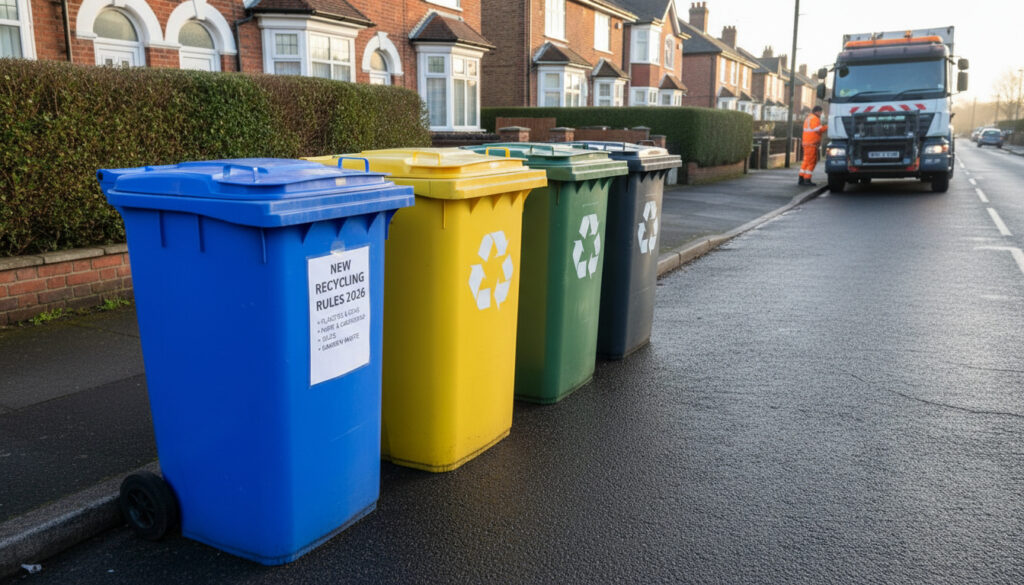
England Bin Collection Rules 2026 – What You Need to Know
From 31 March 2026, every household in England will transition to a standardized waste collection system. The Department for Environment, Food and Rural Affairs (DEFRA) will enforce Simpler Recycling rules requiring separate collections for four distinct waste streams, eliminating the current patchwork of local regulations.
Local councils must provide dedicated bins for food waste, paper and cardboard, dry recyclables, and residual waste. The reforms aim to reduce contamination in recycling loads, improve material quality for processing, and divert organic waste from landfills and incinerators.
These changes represent the most significant structural overhaul of domestic waste management in England in decades, affecting collection schedules, bin provision, and sorting responsibilities for millions of households.
What are the new bin collection rules in England for 2026?
The 2026 reforms establish four mandatory waste streams nationwide. Councils must arrange separate collections for each category, ending the “postcode lottery” where neighbouring authorities followed incompatible systems.
Households may receive up to four separate containers for distinct waste streams.
Weekly or frequent collections required for all organic kitchen waste.
Identical rules apply across England regardless of local authority.
Mandatory implementation deadline for all councils.
Key policy shifts include:
- Four distinct waste streams become mandatory in every local authority area
- Food waste requires dedicated weekly or frequent collection to prevent landfill diversion
- Councils must supply necessary bins, potentially up to four per household
- Standardization aims to eliminate confusion from differing council practices
- Contamination reduction targets seek to improve material quality for recycling plants
- Business regulations follow a separate phased timeline from household rules
| Bin Type | Materials Accepted | Collection Frequency |
|---|---|---|
| Food Waste | Raw and cooked food, dairy, meat, bones, vegetable peelings | Weekly or frequent |
| Paper & Cardboard | Newspapers, magazines, office paper, cardboard boxes, cartons | As scheduled by council |
| Dry Recyclables | Plastic bottles and containers, metal tins and cans, glass bottles and jars | As scheduled by council |
| Residual Waste | Non-recyclable general rubbish, wrappers, broken ceramics | As scheduled by council |
| Plastic Containers Only | Bottles, tubs, trays (specified containers) | With dry recyclables |
| Metal Packaging | Steel tins, aluminium cans, empty aerosols | With dry recyclables |
| Glass Packaging | All colours of bottles and jars (lids removed) | With dry recyclables |
When do the new recycling rules in England start?
The mandatory start date for household collections is 31 March 2026. From this date, all local councils in England must provide the four-stream collection service.
Preparations are already underway as authorities procure bins, update contractor agreements, and plan modified collection rounds. The transition requires significant logistical coordination, particularly in rural and densely populated urban areas where storage space for multiple bins presents challenges. Check MOT and Road Tax compliance follows similarly strict deadlines, though unrelated to waste management.
No transitional grace period for households is detailed in current guidance. Councils must achieve full compliance by the March deadline, though the specific phasing of bin deliveries and schedule changes may vary by location in the months preceding implementation.
How many bins will households in England have in 2026?
Households may receive up to four separate bins or containers under the standardized system. The exact configuration depends on council procurement decisions and local housing density, including storage constraints for flats and terraced properties.
What materials go in each bin?
Food waste requires a dedicated caddy or bin for all organic material including raw and cooked meat, dairy products, tea bags, and vegetable peelings. This stream targets the reduction of methane-producing landfill deposits.
Paper and cardboard must remain clean and dry. Councils may collect this separately or specify co-mingling with dry recyclables depending on local processing facility capabilities.
Dry recyclables encompass plastic containers (bottles, tubs, trays), metal tins and cans, and glass bottles and jars. Lids should be removed and containers emptied before disposal.
Weekly or frequent collections for food waste are mandatory nationwide from 31 March 2026. This stream prevents organic material from contaminating other recyclables and supports composting or anaerobic digestion processing.
Only rigid plastic containers qualify for the dry recyclables stream. Film, flexible packaging, and plastic bags remain excluded unless specifically accepted by individual council contracts.
Is food waste collection mandatory?
Yes. From 31 March 2026, separate food waste collection becomes mandatory for all households in England. Councils cannot offer opt-outs, and residents must use the provided caddies or bins for organic kitchen scraps.
Placing non-recyclable items in the wrong bin may result in entire loads being rejected by processing facilities. Councils report that contaminated batches often undergo landfill or incineration despite containing recyclable materials.
Which councils in England are affected and what are the exceptions?
The rules apply nationwide across England, regardless of local authority boundaries. Rural districts, metropolitan boroughs, and unitary authorities must all implement identical collection standards by the March 2026 deadline.
Current guidance provides no details on exceptions for specific household types, remote rural properties, or high-rise flats with limited bin storage. Similarly, penalty structures for non-compliance remain undefined pending potential DEFRA updates post-implementation. This contrasts with Companies House Identity Verification Launch requirements, where compliance mechanisms were clearly articulated prior to rollout.
Collection frequencies for residual waste and dry recyclables will vary by council based on contractual arrangements and local infrastructure. The regulations mandate the separation of streams but do not prescribe specific weekly or fortnightly schedules for non-food categories.
What is the government’s timeline for implementation?
-
Consultation and Legislation (2023–2025)
DEFRA developed the Simpler Recycling framework following industry consultation, establishing the legal basis for consistent collections. Policy documents detail the technical specifications for waste streams.
-
Mandatory implementation date for household recycling collections. All councils must provide separate bins for food waste, paper/cardboard, dry recyclables, and residual waste. Source: Implementation guidance.
-
Post-Implementation Monitoring (2026 onwards)
Authorities will track contamination rates and recycling tonnages. Legislative updates may establish penalty frameworks or refine collection requirements based on operational data.
What is confirmed and what remains uncertain?
| Established Information | Information That Remains Unclear |
|---|---|
| Four mandatory waste streams from March 2026 | Specific exceptions for rural or inaccessible properties |
| Food waste collection is mandatory nationwide | Penalty structures for household non-compliance |
| Councils must provide bins (up to four per household) | Collection frequencies for non-food waste categories |
| Rules apply consistently across all English councils | Guidelines for flats with limited storage space |
| Dry recyclables include plastics, metals, and glass containers | Enforcement mechanisms for contamination |
Why is England standardizing bin collections?
The reforms address the “postcode lottery” where neighbouring councils operated incompatible recycling systems, causing public confusion and high contamination rates. DEFRA designed the Simpler Recycling strategy to align waste management practices nationally, reducing environmental harm and supporting sustainability targets.
Standardization aims to boost recycling rates by ensuring high-quality material streams that processing plants can handle efficiently. When dry recyclables remain uncontaminated by food waste or residual rubbish, the recovered materials achieve higher market values and support circular economy objectives.
The policy also supports climate goals by diverting organic matter from landfill sites, where decomposition produces methane. Visual summaries indicate households should prepare for up to four separate containers to facilitate proper sorting.
What is the source of these new regulations?
The regulations derive from DEFRA’s Simpler Recycling reforms, established under the Department for Environment, Food and Rural Affairs statutory authority.
These changes stem from DEFRA Simpler Recycling reforms, detailed on gov.uk, to standardize waste management, reduce environmental harm, and meet sustainability goals.
— Environment Waste Management
While the statutory instrument provides the framework, individual councils retain responsibility for operational delivery, contractor management, and local communication strategies.
How should households prepare for the 2026 changes?
Households should monitor communications from their local council regarding bin deliveries and collection calendar updates. Residents can begin practicing waste separation immediately using existing containers, ensuring food waste remains distinct from dry recyclables to minimize contamination risks. Check MOT and Road Tax for vehicle compliance while awaiting council bin provision updates.
Common questions about the 2026 bin rules
Will bin collections become fortnightly?
The regulations do not mandate specific frequencies for dry recyclables or residual waste. While food waste requires weekly or frequent collection, councils retain discretion over schedules for other streams based on local capacity.
What are the penalties for non-compliance?
Current guidance provides no details on penalties for households failing to sort waste correctly. DEFRA may introduce enforcement mechanisms following the March 2026 implementation date.
Do I need to purchase my own bins?
No. Councils must supply the necessary bins, potentially up to four per household, to ensure compliance with the separation requirements.
Can I opt out of food waste collection?
No. Food waste collection is mandatory for all households from 31 March 2026. Separate organic waste bins must be used as provided by the local authority.
How does this affect businesses?
Businesses face similar sorting requirements under Simpler Recycling rules, though implementation follows a separate phased timeline from the household March 2026 deadline.
What if I live in a flat with no space for four bins?
While the rules apply nationwide, specific guidance for flats and high-density housing remains unclear. Councils must determine practical delivery methods for multi-occupancy buildings.
More related posts
 Slimming World Near Me – Find Local Groups by Day and Distance
 Kpop Demon Hunters Wallpaper – Free Downloads and Guide
 Una Healy Relationships, Kids, and Net Worth: 2025 Update
 International Distribution Services Share Price After Delisting
 John Lackland: History, Magna Carta & Presidential Myths
 Ming-Na Wen: Ethnicity, Famous Roles, and Career Facts
 Prince Harry: Health, Home, and Relationship with King Charles
 Free TV Licence for Pensioners Ireland: Eligibility & How to Apply
