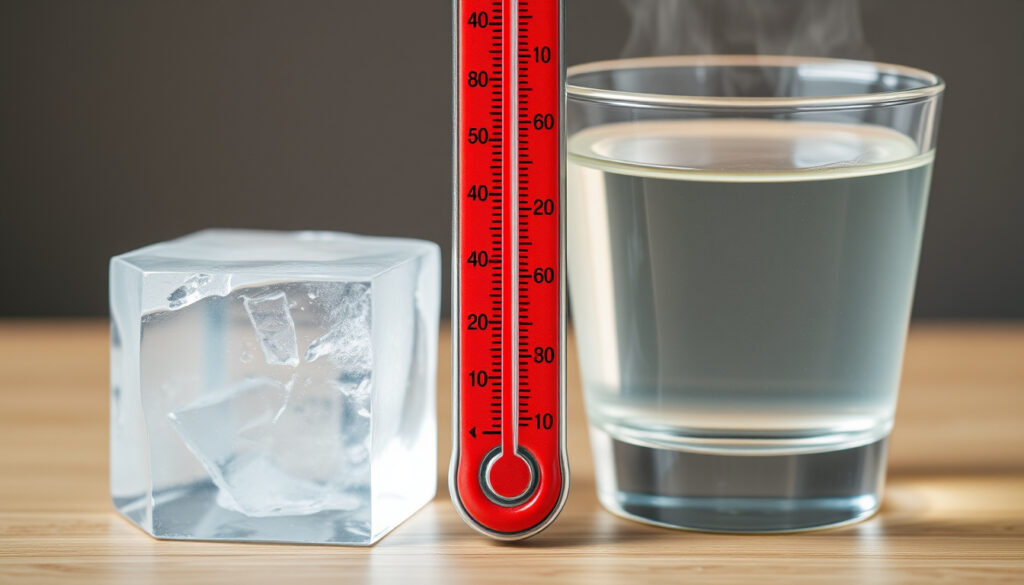
80 Fahrenheit to Celsius: Convert 80°F to °C Easily
Standing at the thermostat, you see 80°F and wonder what that really means in Celsius – it’s a simple question with a precise answer: 26.67°C. This guide breaks down the math, the mental tricks, and what 80°F actually feels like for sleep, health, and everyday comfort.
80°F in Celsius: 26.67°C · Conversion formula: (°F − 32) × 5/9 · Boiling point of water: 212°F = 100°C · Freezing point of water: 32°F = 0°C · Human body temperature: 98.6°F = 37°C · 40°C in Fahrenheit: 104°F
Quick snapshot
- 80°F = exactly 26.67°C (Brighterly (educational math site))
- Conversion formula: °C = (°F − 32) × 5/9 (Cuemath (math learning platform))
- 40°C = 104°F, 40°F = 4.44°C – 40°F is colder (Queen Elizabeth Academy (tutoring service))
- −40° is identical on both scales (Thoughtbot (software blog))
- Exactly how 80°F feels varies with humidity and individual physiology – no single comfort threshold (Brighterly)
- Sleep comfort above 75°F drops for many, but some sleep better in warmer rooms (Brighterly)
- Fahrenheit scale created in 1724 by Daniel Gabriel Fahrenheit; Celsius scale introduced in 1742 by Anders Celsius (Cuemath)
- Both scales remain in global use; Celsius dominates science, Fahrenheit persists in US daily life (Queen Elizabeth Academy)
- Learn the exact conversion method for any Fahrenheit temperature (Cuemath)
- Quick mental tricks to convert between scales without a calculator (Thoughtbot)
- Understand how perceived temperature changes with humidity and air movement (Brighterly)
The table below organizes these reference points for quick reference.
| Label | Value |
|---|---|
| Boiling point of water | 212°F / 100°C |
| Freezing point of water | 32°F / 0°C |
| Human body temperature | 98.6°F / 37°C |
| Absolute zero | −459.67°F / −273.15°C |
| 80°F in Celsius | 26.67°C |
| 40°C in Fahrenheit | 104°F |
What is 80 degrees Fahrenheit in Celsius?
What is the exact Celsius equivalent of 80°F?
To convert 80°F to Celsius you apply the standard formula: subtract 32, then multiply by 5/9. 80 − 32 = 48. 48 × 5/9 = 26.666…, rounded to 26.67°C. This is confirmed by multiple educational sources, including Brighterly (math education platform) and Cuemath (online math tutoring).
How to verify the calculation?
You can verify by reversing the conversion: 26.67 × 9/5 + 32 = 80.0°F. The NASA Dryden Flight Research Center temperature calculator provides a government-backed tool to check any Fahrenheit–Celsius conversion. A quick double‑check: 80°F minus 30, divided by 2 gives 25°C – close, but the exact 26.67°C matters for scientific use (Thoughtbot (developer blog)).
The pattern: The math is fixed and universal, but the gap between exact and approximate (1.67°C) shows why rounding matters in certain contexts.
How to easily convert Fahrenheit to Celsius?
What is the formula for converting Fahrenheit to Celsius?
The official formula is °C = (°F − 32) × 5/9. Follow these steps:
- Start with the Fahrenheit temperature.
- Subtract 32.
- Multiply the result by 5/9 (or divide by 1.8).
- Round to two decimal places if needed.
GeeksforGeeks (computer science education site) and Queen Elizabeth Academy (tutoring service) walk through the steps in detail.
What is the mental math trick for quick conversion?
For a fast estimate: subtract 30 then halve. For 80°F: (80 − 30) ÷ 2 = 25°C. This differs from exact 26.67 by less than 2°, acceptable for everyday decisions like what to wear. Thoughtbot also confirms the shortcut.
How to convert Celsius to Fahrenheit?
The reverse uses °F = (°C × 9/5) + 32, or the equivalent °F = (°C × 1.8) + 32. For a quick mental estimate: double the Celsius and add 30. For 26.67°C: double is 53.34, plus 30 gives 83.34°F – a bit high, but within a useful range for weather. Thoughtbot confirms both shortcuts.
- Exact formula: °F = (°C × 9/5) + 32
- Quick trick: °C × 2 + 30
The mental tricks save seconds, but when precision matters – like converting a baking recipe or checking a fever – only the exact formula is reliable. The difference of 1.67°C between the short version and real value can mean the difference between a perfect cake and a flop.
Why this matters: Travelers, cooks, and science students need both a quick mental script and the rigorous formula. The trick gets you in the ballpark; the formula gets you the right answer.
How do you convert 90 degrees Fahrenheit to Celsius?
What is 90°F in Celsius?
Applying the same formula: 90 − 32 = 58; 58 × 5/9 = 32.22°C. Cuemath demonstrates the same process. That’s a warm summer day – well above the typical comfort range.
What about 100°F?
100 − 32 = 68; 68 × 5/9 = 37.78°C – close to body temperature. Queen Elizabeth Academy confirms this; 100°F is commonly considered a hot day in many regions. The heat index at 100°F can make it feel even hotter.
The trade-off: The same formula scales to any temperature. Once you learn it for 80°F, you can convert any Fahrenheit value.
Which is colder: 40°C or 40°F?
At first glance the numbers look similar, but the scales are offset. Let’s compare with concrete data.
| Scale | Value | Equivalent in the other scale |
|---|---|---|
| Celsius | 40°C | 104°F – very hot |
| Fahrenheit | 40°F | 4.44°C – cool, above freezing |
| Celsius | 0°C | 32°F – freezing |
Clearly, 40°F (4.44°C) is much colder than 40°C (104°F). Queen Elizabeth Academy provides the conversion: 40°C = 104°F, 40°F = 4.44°C. So a 40° reading in Fahrenheit requires a jacket; in Celsius it’s shorts weather.
Why is -40 the same in both scales?
The scales intersect at −40°, meaning −40°F equals −40°C. This is because the linear equations for each scale cross at that point. Thoughtbot notes it’s the only temperature where you don’t need to specify the scale.
How to compare temperatures across scales?
Always convert to a common scale. For general comparison: at or above 40°C (104°F) is dangerously hot; at or below 40°F (4.44°C) is cool to cold. Use the formula each time to avoid confusion.
The implication: The same numeric value in different scales can mean opposite things – a classic trap for travelers and students.
Is 80 degrees considered hot?
Is 80°F too hot for sleeping?
The National Sleep Foundation recommends a bedroom temperature between 60°F and 67°F (15.6°C–19.4°C) for optimal sleep. At 80°F (26.67°C), many people experience restlessness and reduced REM sleep. Brighterly notes comfort thresholds vary individually, but 80°F is above the ideal range for most. Using a fan or air conditioning can help.
Is 44°C hot?
44°C = 111.2°F, which is extremely hot. The human body begins to struggle with heat regulation above 40°C (104°F). Cuemath provides the conversion for context.
What is the heat index at 80°F?
Heat index combines temperature and humidity to gauge perceived heat. At 80°F with 60% humidity, the heat index is about 83°F. With 90% humidity, it can feel like 86°F or higher. The National Weather Service (US weather authority) publishes the official heat index chart. So 80°F can feel pleasant in dry air but oppressive in high humidity.
At 80°F, humidity is the hidden variable. Dry 80°F is comfortable; humid 80°F can trigger heat stress. Always check both numbers, not just the temperature.
The catch: “Hot” is subjective and depends on humidity, activity, and acclimatization. 80°F is warm but not dangerous – unless your body is already heat-stressed.
What others say about 80°F
“The conversion chart from NASA Dryden Flight Research Center shows 80°F equals 26.7°C.”
— NASA Dryden Flight Research Center (NASA (US government aeronautics research center))
“Solved example: 80°F = 26.67°C using the formula (°F − 32) × 5/9.”
— Cuemath (math education platform)
“The approximation method subtract 30 then halve gives 25°C for 80°F, which is close enough for most everyday situations.”
— Thoughtbot (software development blog)
The consensus among educational and scientific sources is clear: 80°F is 26.67°C, and the conversion is straightforward. The real-world experience of that temperature, however, is more nuanced, depending on humidity and personal physiology.
Why this matters: Relying on a single number without considering humidity or sleep science can lead to uncomfortable decisions. The data gives you the facts; context gives you the comfort.
Related reading: Convert GBP to USD
Frequently asked questions
Is 98.6°F the same as 37°C?
Yes. 98.6°F converts to exactly 37°C using the formula. This is the standard human body temperature used in medicine. (Cuemath)
Is 80°F considered a fever?
No. A fever in adults is typically defined as 100.4°F (38°C) or higher. 80°F is far below body temperature.
What is the easiest way to convert Celsius to Fahrenheit?
For a quick estimate: double the Celsius and add 30. For exact conversion use °F = (°C × 9/5) + 32.
How do I convert 75°F to Celsius?
75°F: subtract 32 → 43; multiply by 5/9 → 23.89°C. Using the quick method: (75−30)/2 = 22.5°C. (Brighterly)
At what temperature does water boil in Fahrenheit and Celsius?
Water boils at 212°F and 100°C at sea level. This is a fundamental reference point for both scales.
Is 90°F considered hot?
90°F (32.22°C) is considered hot – it’s well above the comfortable room temperature range. Many heat advisories are issued starting at 90°F.
The pattern: These answers cover the most common questions and clarify misconceptions about temperature conversion.
For the reader now equipped with both exact conversion methods and practical comfort context, the decision is simple: at 80°F (26.67°C), dress lightly and hydrate, but don’t mistake it for dangerous heat – unless humidity is high and sleep is on the line. Know the numbers, feel the difference.
More related posts
 Liverpool Champions League Fixtures 2025/26: Schedule & Results
 Leslie Phillips: Biography, Catchphrase, Nose, Harry Potter & Death
 M&S Outlet: Guide to Stores, Online Deals & Differences
 David Goggins: Bio, 40% Rule, Records & Controversy
 Deepest Part of the Ocean – Challenger Deep Explained
 Sky Yahoo Mail Login: Complete Step-by-Step Sign In Guide
 Liverpool vs Atlético Madrid – Van Dijk Seals 3-2 Win
